IEC 61131-3 defined the era of traditional PLCs, while IEC 61499 is leading industrial automation toward a more open and distributed future.
In the field of industrial automation, standards determine system architecture, development methods, and future scalability. The IEC 61131-3 and IEC 61499 standards, both developed by the International Electrotechnical Commission (IEC), represent two distinct eras of automation philosophy:
- One is the core standard for traditional PLC control.
- The other is a key framework for distributed control in the Industry 4.0 era.
So, what exactly are the differences between them, and how should you choose?
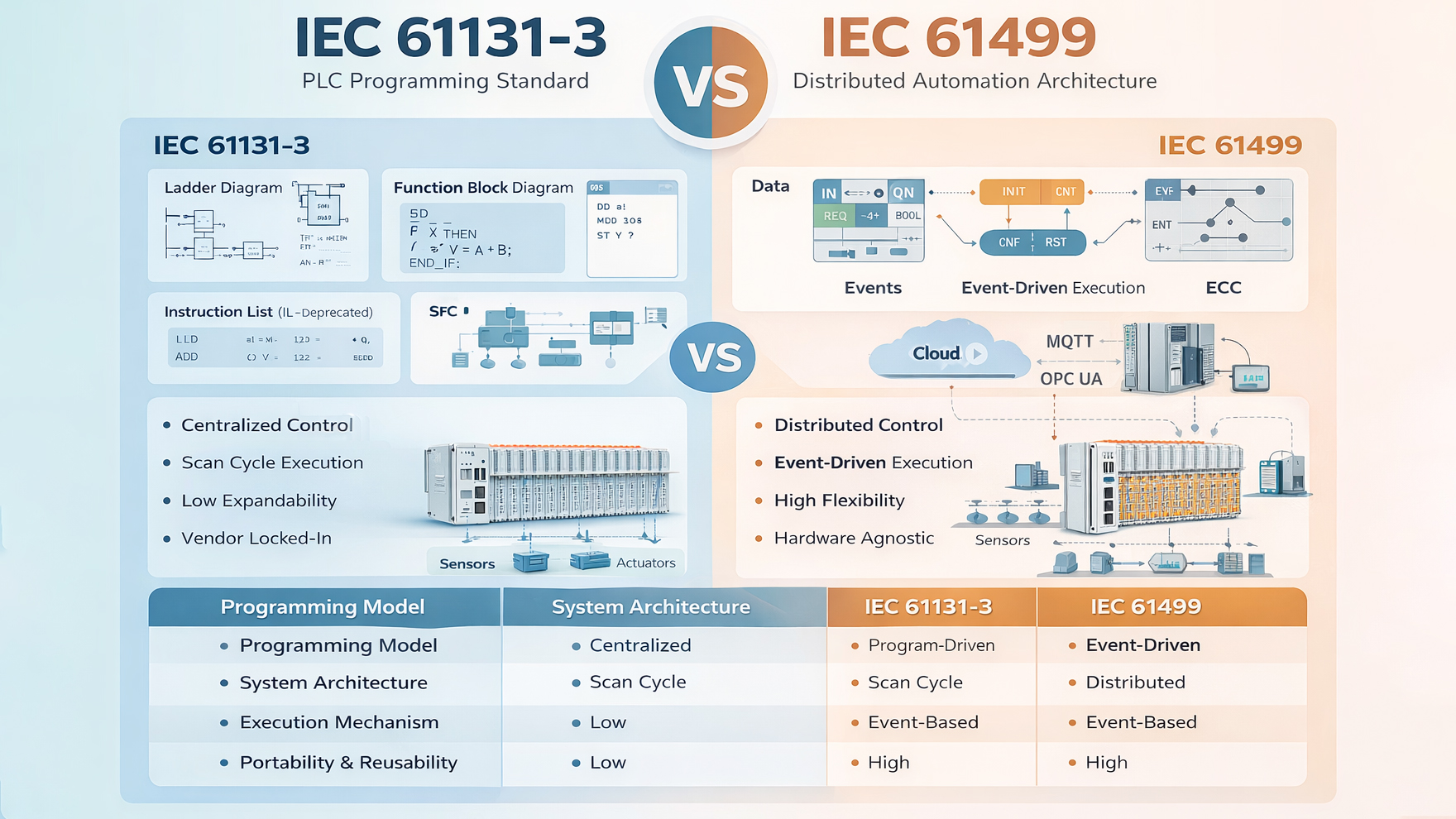
IEC 61131-3: The Foundation of Traditional PLC Automation
IEC 61131-3 is currently the most widely adopted industrial control programming standard. Almost all major PLC manufacturers (such as Siemens, Schneider Electric, and Mitsubishi) base their systems on this standard.
Core Features
1️⃣ Multi-Language Support IEC 61131-3 provides five standardized programming languages:
- LD (Ladder Diagram)
- ST (Structured Text)
- FBD (Function Block Diagram)
- SFC (Sequential Function Chart)
- IL (Instruction List — gradually being phased out)
This allows engineers to flexibly choose the most suitable programming method according to the application scenario.
2️⃣ Scan Cycle Execution Mechanism Traditional PLCs operate on a fixed periodic cycle:
Read Inputs → Execute Program → Update Outputs → Repeat
Advantages:
- Highly stable and reliable
- Predictable behavior
- Easy to debug
Limitations:
- Response time depends on the scan cycle
- Not suitable for complex event-driven systems
3️⃣ Centralized Control Architecture Typical structure:
Sensors → PLC → Actuators
Characteristics:
- All logic is concentrated in a single controller
- System expansion depends on the PLC’s performance
- Limited capability for cross-device collaboration
Typical Application Scenarios
- Machine control
- Production line automation
- High real-time, structurally simple systems
Summary: IEC 61131-3 excels in “stable control” but is weak in “flexible scalability.”
IEC 61499: The Distributed Control Model for Industry 4.0
IEC 61499 is a next-generation standard designed to address the complexity of modern industrial systems. It emphasizes distributed, modular, and event-driven architectures.
Core Features
1️⃣ Event-Driven Execution Unlike traditional PLCs, IEC 61499 does not rely on a fixed scan cycle. Instead:
👉 Execution is triggered by events
Examples:
- Data changes trigger logic execution
- External events trigger function block operation
Advantages:
- Faster response
- More resource-efficient
- Better suited for complex systems
2️⃣ Function Block Architecture The core of IEC 61499 is the enhanced Function Block (FB). Each function block contains:
- Data interfaces
- Event interfaces
- Execution Control Chart (ECC — a state machine)
👉 Similar to “components” or “microservices” in software engineering.
3️⃣ Native Distributed Support The system can run across multiple devices:
Sensors → Edge Controller → Cloud → Other Controllers
It supports:
- Multi-controller collaboration
- Dynamic deployment
- Network communication (MQTT, OPC UA, etc.)
4️⃣ High Portability IEC 61499 emphasizes:
- Hardware independence
- Application portability
- Cross-platform deployment
👉 Reduces dependency on a single vendor.
Typical Application Scenarios
- Industrial Internet of Things (IIoT)
- Edge Computing
- Intelligent manufacturing systems
- Distributed production lines
Summary: IEC 61499 excels in “flexibility and connectivity” and represents the future trend.
Core Comparison
| Dimension |
IEC 61131-3 |
IEC 61499 |
| Control Mode |
Program-driven |
Event-driven |
| Execution Mechanism |
Cyclic scanning |
On-demand triggering |
| System Architecture |
Centralized |
Distributed |
| Scalability |
Limited |
Strong |
| Portability |
Low |
High |
| Industrial Stage |
Industry 3.0 |
Industry 4.0 |
Why Is the Industry Shifting Toward IEC 61499?
As industrial systems become increasingly complex, traditional PLC architectures face growing challenges:
- Difficult multi-device coordination
- Severe data silos
- Hard to integrate with cloud platforms
- High expansion costs
IEC 61499 provides effective solutions: ✅ Distributed control ✅ IT/OT convergence ✅ Cloud-edge collaboration ✅ Modular development
Especially suitable for:
- Edge PLCs
- Industrial edge gateways
- AI + Automation systems
How to Choose?
Choose IEC 61131-3 if you:
- Are working on traditional machine control
- Have simple project structures
- Require extremely high stability
- Are using mature PLC systems
Choose IEC 61499 if you:
- Are building smart factories or Industrial IoT systems
- Need multi-device collaboration
- Want long-term scalability
- Are using edge computing or cloud architectures
Conclusion
IEC 61131-3 defined the era of traditional PLCs, while IEC 61499 is leading industrial automation toward a more open and distributed future.
With the advancement of Industry 4.0, control systems are evolving from “single-device control” to “system-level collaboration and intelligent decision-making.” In this trend, control platforms that support IEC 61499 are becoming the core of next-generation industrial architectures.
Modern EdgePLC not only inherit the stability and reliability of traditional PLCs but also integrate edge computing and distributed control capabilities. They fully support the IEC 61499 architecture, making them particularly outstanding in the following scenarios:
- Upgrading industrial automation systems
- Building Industry 4.0 smart factories
- Multi-device collaborative control
- Deep integration of IT and OT
EdgePLC = PLC + Edge Computing + Distributed Control
This makes EdgePLC the key hub connecting the device layer, control layer, and cloud platform, providing a solid foundation for enterprises to build more flexible, intelligent, and scalable industrial systems.


