CAN FD enhances CAN with faster speeds and larger data frames, enabling more efficient, real-time communication and better integration with modern industrial and cloud systems.
In today’s era of rapid development in industrial automation and intelligent devices, the performance of communication buses directly determines the efficiency and reliability of the entire system. As one of the most widely used fieldbuses, CAN (Controller Area Network) has been operating stably in automotive electronics and industrial control fields for decades. However, with the increasing demand for larger data volumes and higher real-time performance, traditional CAN is gradually revealing its limitations, while CAN FD (Flexible Data-Rate) has emerged as the next-generation solution.
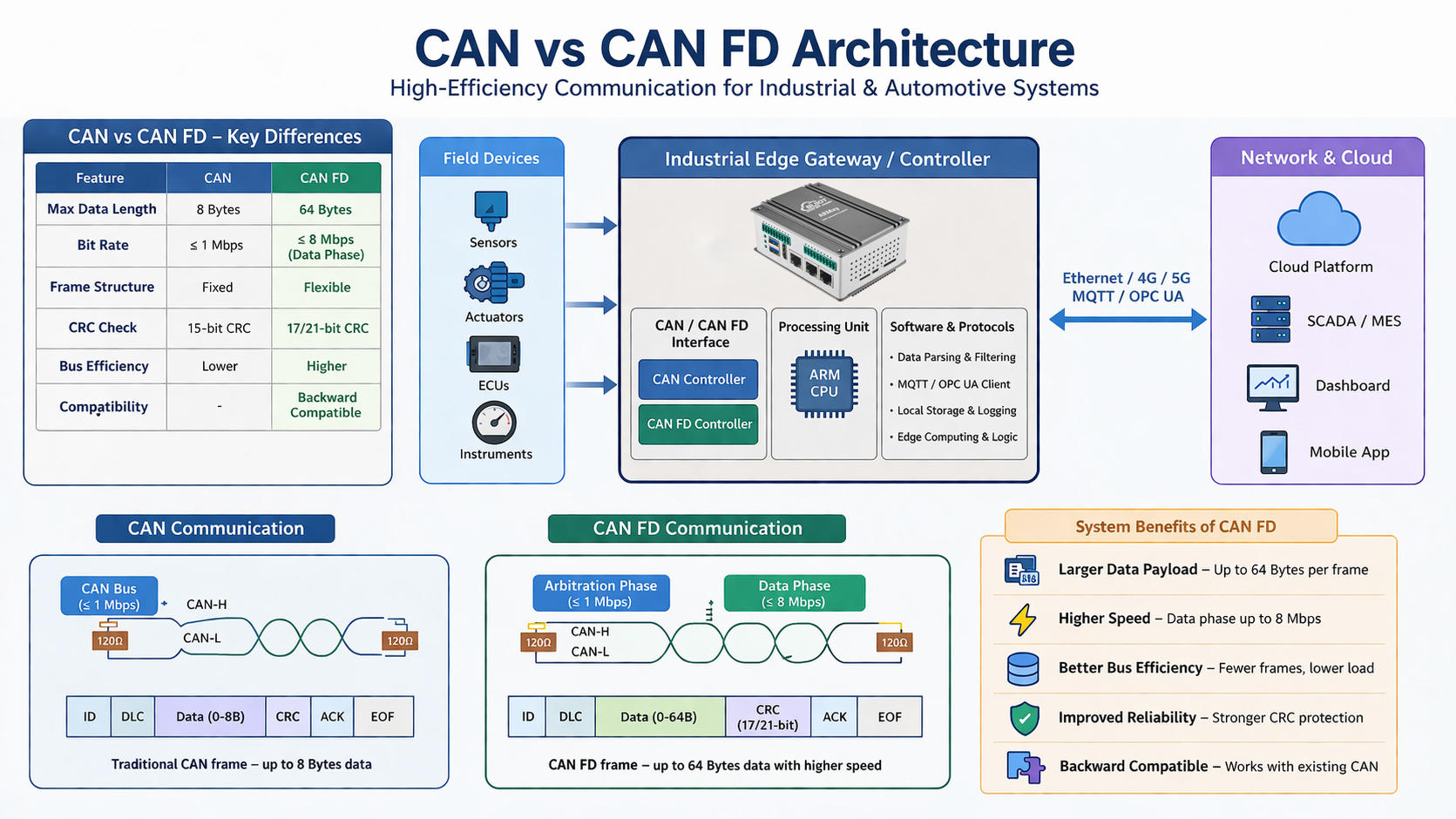
From CAN to CAN FD: Why Is an Upgrade Needed?
The traditional CAN bus was developed in the last century, originally designed to meet the reliable communication requirements between ECUs inside vehicles. It offers high immunity to interference and low cost, but it is increasingly unable to satisfy modern demands in the following aspects:
- Single frame data supports only 8 bytes
- Maximum communication rate of 1 Mbps
- Low transmission efficiency for large amounts of data
With the development of the Industrial Internet of Things (IIoT), new energy vehicles, and edge computing, devices now need to transmit ever-increasing volumes of data, such as:
- High-precision sensor data
- Battery Management System (BMS) data
- Real-time control and status monitoring information
This is the background behind the emergence of CAN FD.
Core Advantages of CAN FD
1️⃣ Larger Data Capacity CAN FD increases the single-frame data length from 8 bytes to 64 bytes, bringing significant improvements:
- Reduced need for message segmentation and reassembly
- Lower bus load
- Higher overall communication efficiency
👉 In industrial data acquisition scenarios, this means more sensor data can be transmitted in a single frame.
2️⃣ Higher Transmission Speed CAN FD introduces a variable data-rate mechanism:
- Arbitration phase: remains ≤ 1 Mbps (ensuring backward compatibility with traditional CAN)
- Data phase: increased to 5–8 Mbps
The advantages of this design are:
- Maintained system compatibility
- High-speed communication during critical data transmission phases
👉 Particularly suitable for control systems with high real-time requirements.
3️⃣ Higher System Reliability CAN FD adopts a longer CRC (Cyclic Redundancy Check) mechanism, making communication more reliable:
- Reduced bit error rate
- Improved data integrity
- Better suited for complex industrial environments
CAN vs CAN FD: Comprehensive Comparison
| Item |
CAN |
CAN FD |
| Single-frame data |
8 Bytes |
64 Bytes |
| Data rate |
≤ 1 Mbps |
≤ 8 Mbps |
| Bus efficiency |
Lower |
Higher |
| Real-time performance |
Average |
Superior |
| Compatibility |
- |
Backward compatible |
Typical Application Scenarios
🔧 Traditional CAN
- PLC control systems
- Industrial I/O modules
- Traditional automotive ECU communication
👉 Suitable for: low data volume, stable control scenarios
🚀 CAN FD
- New energy vehicles (BMS, motor control)
- Industrial edge computing gateways
- Smart manufacturing production lines
- High-speed data acquisition systems
👉 Suitable for: high data volume, high real-time performance scenarios
Value in Industrial Edge Computing
In modern ARM-based edge controllers and industrial gateways, CAN FD is gradually becoming one of the standard interfaces. Its value is reflected in:
- High-speed data interaction with sensors and instruments
- Integration with cloud platforms via MQTT or OPC UA
- Support for data fusion and analysis in complex industrial systems
For example, an edge gateway can quickly collect equipment data through CAN FD, then upload it to the cloud via Ethernet or 4G, achieving a true Industrial IoT closed loop.
Conclusion
CAN FD is not a simple upgrade of CAN, but a critical evolution toward future communication needs.
👉 Larger data capacity + Higher speed + Stronger reliability
It is becoming the new standard for communication in industrial automation and intelligent devices.
For engineers designing next-generation industrial equipment or edge control systems, choosing CAN FD is not only a performance improvement — it is a forward-looking technological strategy.


