Beilai EA Series industrial edge AI computer powered by the complete CUDA+TensorRT ecosystem, it natively supports commercial vision libraries including Halcon, with outstanding advantages in 3D stereo matching, multi-channel parallel AI inference and non-standard image processing. Featuring industrial wide-temperature design.
4-Channel Industrial Camera Vision Solution | Beilai EA Series: Leverage the CUDA Ecosystem for High-End Machine Vision
In manufacturing production lines for lithium batteries, 3C semiconductors, photovoltaics, automotive components and robot sorting, multi-view synchronous visual inspection has become an essential requirement. Projects such as four-sided appearance inspection, binocular 3D grabbing, large-panel image stitching and multi-surface DPM code reading often require 4 industrial cameras working simultaneously.
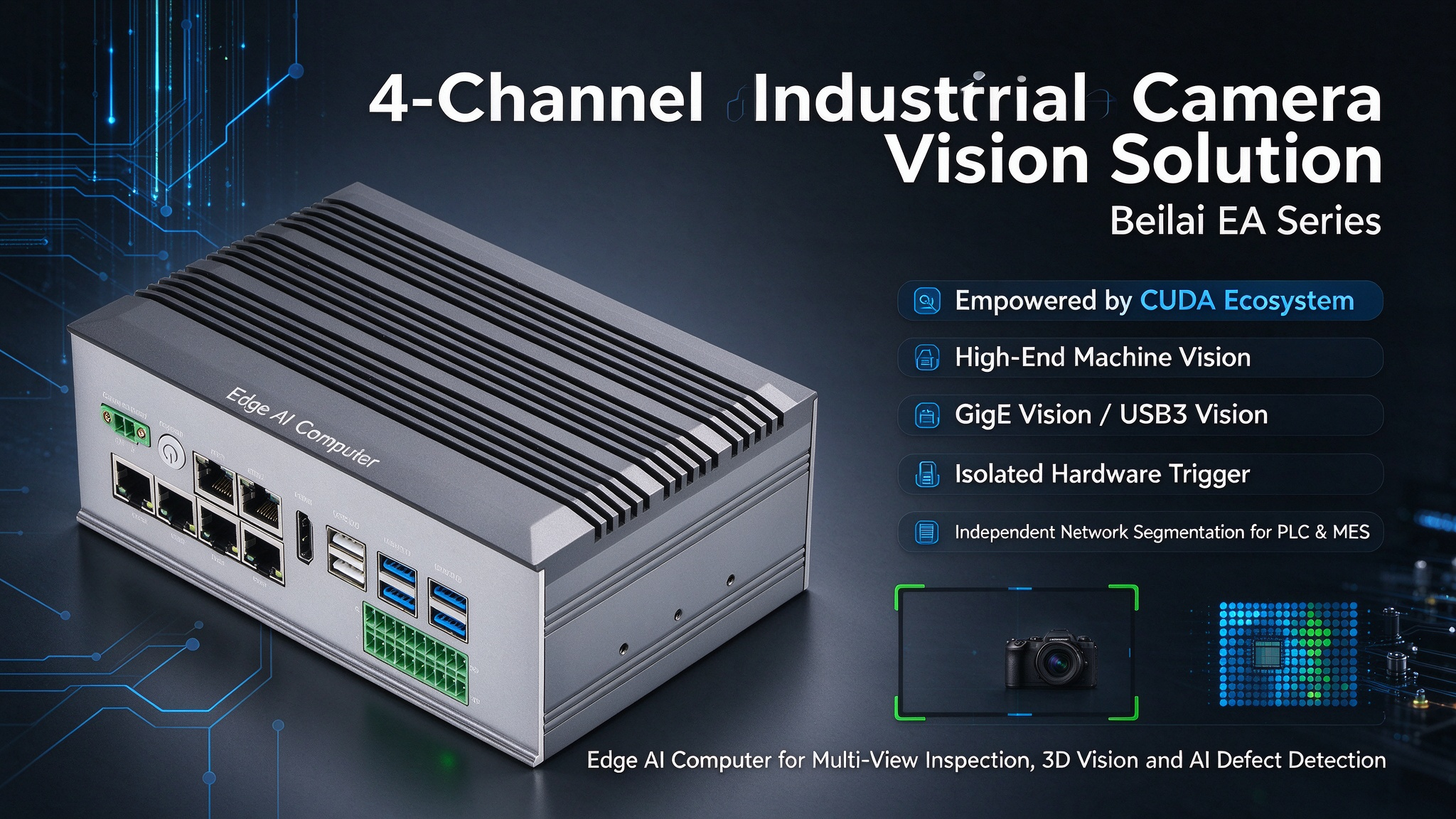
The Beilai EA Series industrial edge AI computers natively support connection of up to 4 industrial cameras, compatible with GigE Vision PoE and USB3 Vision, and work seamlessly with mainstream camera brands including Hikvision, Dahua, Basler and Daheng. They feature isolated PWM hardware trigger and Strobe flash synchronization. With an isolated multi-network port architecture, image acquisition, AI inference, PLC interlocking and MES data upload can be realized in one integrated system.
Typical Application Scenarios of EA Series with 4 Industrial Cameras
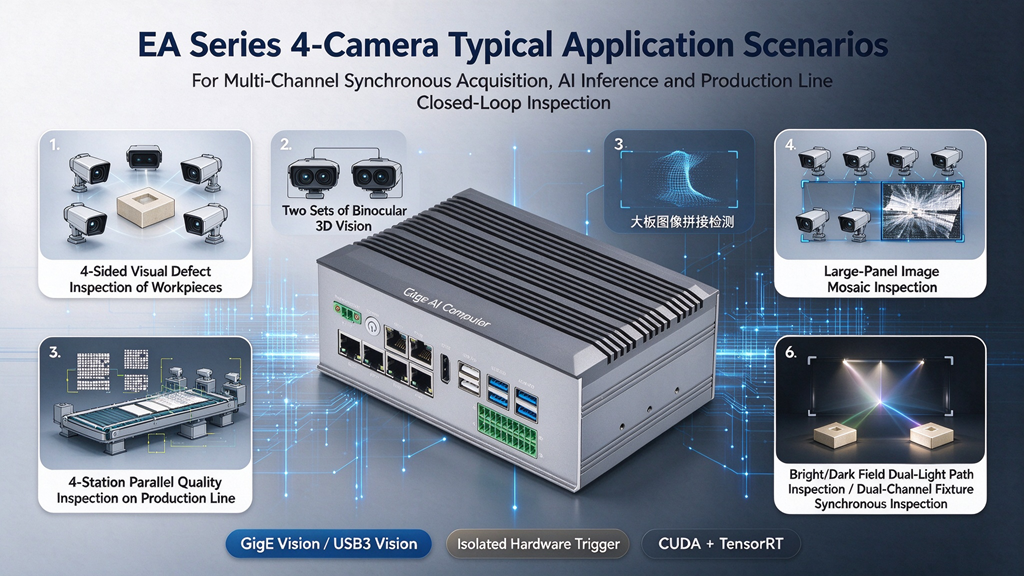
🔹 Four-sided appearance defect inspection for workpieces Four cameras are arranged around the workpiece to capture images of four sides synchronously, detecting scratches, burrs, material shortage, stains and printing defects in one capture. Widely used for battery cells, die castings, connectors and plastic housings.
🔹 Dual sets of binocular 3D vision Two binocular camera groups (4 cameras in total) for 3D contour reconstruction, height/warpage measurement, weld inspection and 6D pose grabbing for robots, suitable for depalletizing and mixed-material feeding.
🔹 Large-panel stitching inspection Images captured by 4 cameras in a matrix layout are stitched together to realize full inspection of PCBs, FPCs, photovoltaic panels and glass covers at a large field of view, reducing hardware cost compared with line scan cameras.
🔹 Parallel inspection at 4 pipeline stations Four inspection positions on one production line, performing incoming material detection, dimension measurement, defect inspection and DPM/OCR laser marking recognition simultaneously.
🔹 Multi-surface DPM character reading Synchronously capture images of multiple marked surfaces of parts to identify low-contrast laser codes, VIN codes and batch serial numbers.
🔹 Bright/dark field dual optical path inspection / Synchronous inspection for dual-channel tooling Image difference comparison between bright and dark fields captures subtle defects; synchronous inspection of two workpieces improves equipment throughput.
Note on network planning: For the 4×GigE camera configuration, physical isolation of multiple network adapters is adopted. Camera data stream, real-time PLC control and MES upload run on separate network segments to prevent image traffic from occupying control bandwidth and ensure stable closed-loop timing on the production line.
Core Differentiated Advantages of the CUDA + TensorRT Ecosystem for EA Series
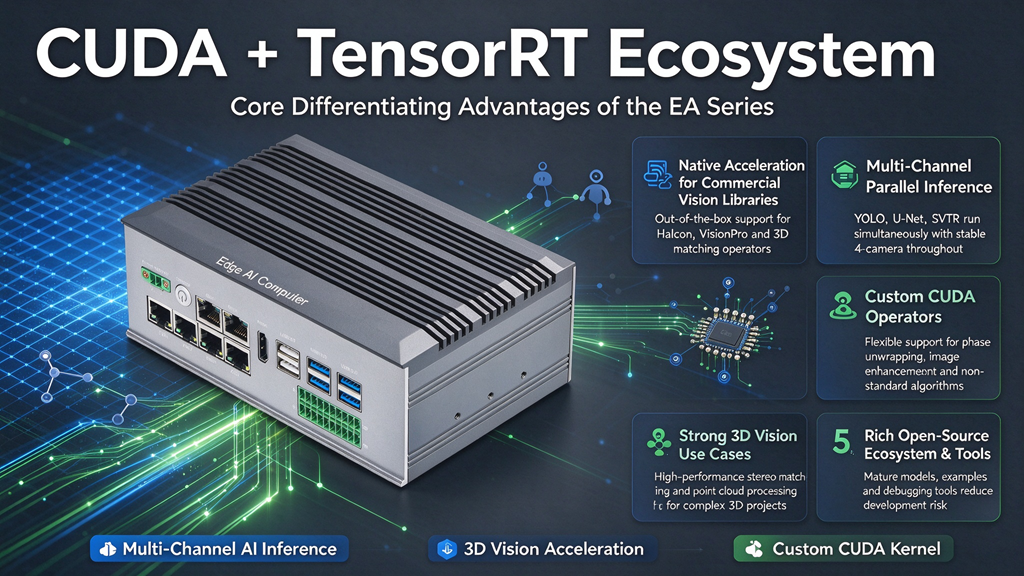
The EA Series is built on the NVIDIA Jetson Orin platform with a complete CUDA and TensorRT software stack, which is the core advantage for complex vision projects:
▫️ Native CUDA acceleration for commercial vision libraries such as Halcon and VisionPro. Operators for 3D matching and sub-pixel measurement are ready to use, greatly shortening project development cycles.
▫️ TensorRT model optimization supports parallel inference of YOLO, U-Net and SVTR models. With synchronous acquisition from 4 high-resolution cameras, it achieves lower latency and stable tact time for high-speed production lines.
▫️ High operator flexibility with support for custom CUDA kernels, making it easy to implement non-standard algorithms such as phase unwrapping and image enhancement, without being limited by the fixed operator set of NPUs.
▫️ 3D stereo matching and point cloud processing are flagship applications of CUDA, making it the preferred platform for 3D vision system integrators.
▫️ Abundant open-source cases and debugging tools with solid technical accumulation reduce trial-and-error costs.
Industrial Features of the Product
- Power supply: 12~24VDC wide-range input
- Operating temperature: -20℃ ~ +75℃ wide temperature range
- EMC: Meets Level 3 industrial immunity standards (ESD / EFT / Surge)
- Interfaces: Isolated PWM camera trigger, Strobe synchronous output, CAN FD, RS485. Supports expansion of N-series IO modules to connect PLCs and actuators
- Software: JetPack + Ubuntu, supports Docker and remote operation & maintenance for mass delivery
Selection Guide
- For high-end 3D vision, complex defect segmentation, multi-channel high-resolution cameras and Halcon-based development → EA Series (CUDA Platform)
- For basic 2D inspection with local Codesys soft PLC hard real-time control required → BL Series EdgePLC
The EA Series is an industrial-grade box computer. It delivers stable edge vision solutions for intelligent manufacturing by integrating multi-channel image acquisition, AI analysis, equipment interlocking and data uploading, and can be directly deployed on mass-production production lines.