An edge computing controller is an embedded control device deployed on-site in industrial settings or near equipment. It not only possesses the real-time control capabilities of traditional PLCs (Programmable Logic Controllers) but also integrates edge computing, data acquisition, protocol conversion, network communication, and intelligent analysis.
What is an Edge Computing Controller?
Amid the rapid development of Industry 4.0 and the Internet of Things (IoT), traditional control and computing architectures are undergoing profound transformation. The edge computing controller, serving as an intelligent hub connecting physical devices and the digital world, is increasingly becoming a critical piece of equipment in fields such as smart manufacturing, energy management, and industrial automation. This article will use Shenzhen Beilai Technology Co., Ltd.'s ARMxy BL460 Series as an example to delve into the definition, functions, technical characteristics, and application value of edge computing controllers.
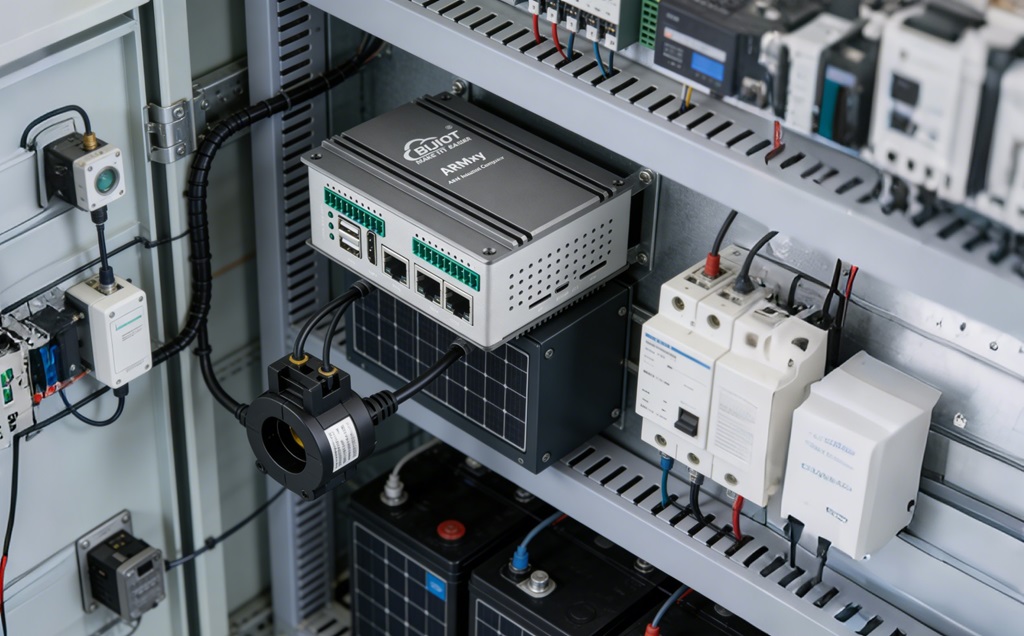
1. Definition of an Edge Computing Controller
An edge computing controller is an embedded control device deployed on-site in industrial settings or near equipment. It not only possesses the real-time control capabilities of traditional PLCs (Programmable Logic Controllers) but also integrates edge computing, data acquisition, protocol conversion, network communication, and intelligent analysis. Its core objective is to process and analyze data at its source, achieving the "integration of control and computing," thereby reducing cloud workload and enhancing system responsiveness and reliability.
Compared to the traditional "PLC + Industrial PC" architecture, edge computing controllers offer significant advantages in hardware integration, software openness, and system flexibility, making them a key enabler for the convergence of IT (Information Technology) and OT (Operational Technology).
2. Why is an Edge Computing Controller Needed?
As industrial systems become increasingly complex, with growing numbers of field devices and diversified data types, traditional architectures face the following challenges:
-
High Real-time Requirements: Scenarios like motion control and machine vision demand microsecond-level responses.
-
Large Data Volume with Strong Local Processing Needs: Preprocessing data streams like video and sensor data locally reduces bandwidth pressure.
-
Diverse Protocols Requiring Interconnection: Multiple industrial protocols such as Modbus, EtherCAT, OPC UA, and MQTT require unified conversion and interfacing.
-
Complex Operation and Maintenance: Widely distributed devices in harsh environments necessitate support for remote configuration, diagnosis, and updates.
-
Intelligent Upgrades: AI inference, predictive maintenance, etc., require deploying lightweight models at the edge.
Edge computing controllers are born precisely to address these issues, enabling "data to speak at the edge, and control to be managed locally."
3. Core Technical Characteristics of Edge Computing Controllers
Taking the ARMxy BL460 Series as an example, a typical edge computing controller possesses the following technical features:
1. Powerful Hardware Platform
-
Multi-core High-performance Processor: e.g., Broadcom BCM2712, quad-core Cortex-A76, 2.4GHz clock speed, supporting AI inference and complex computations.
-
Flexible Storage Configuration: Supports 8–64GB eMMC storage and 2–16GB LPDDR4X memory, meeting diverse application needs.
-
Rich Expansion Interfaces: Supports X/Y-series I/O modules, RS485/CAN/DI/DO/AI/AO, etc., flexibly adapting to various sensors and actuators.
-
Industrial-grade Design: Wide-temperature operation (-20℃ to 85℃), DIN rail mounting, electromagnetic interference resistance, and equipped with an independent hardware watchdog.
2. Open Software Ecosystem
-
Multi-OS Support: Linux, Raspberry Pi OS, etc., compatible with Docker containerized deployment.
-
Integration of Control and Computing: Supports control systems like Codesys and OpenPLC compliant with IEC 61131-3 standards, while also capable of running development environments like Python, Node-RED, and QT.
-
Seamless Protocol Interfacing: Built-in BLIoTLink protocol conversion software supporting mainstream industrial protocols like Modbus, EtherCAT, OPC UA, and MQTT.
-
Remote Operation and Maintenance Tools: Integrates BLRAT remote access and QuickConfig rapid configuration tools, enabling "zero-touch" device deployment and management.
3. Modularity and Scalability
-
Modular Design: Motherboard + SOM + I/O board can be combined, allowing users to select processors, memory, and interface types based on needs.
-
Supports 4G/5G, WiFi, Bluetooth Communication: Adapts to different network environments.
-
Optional 40-pin Expansion Board: Compatible with the Raspberry Pi ecosystem, facilitating secondary development and functional expansion.
4. Typical Application Scenarios
Edge computing controllers are widely used in the following fields:
5. Future Trends of Edge Computing Controllers
With the advancement of technologies like AI, 5G, and digital twins, edge computing controllers will evolve in the following directions:
-
Smarter: Integration of AI acceleration units like NPUs and GPUs to support local visual recognition and anomaly detection.
-
More Open: Development of standardized edge app stores supporting app-like deployment and management.
-
More Secure: Enhanced security mechanisms such as hardware encryption, secure boot, and trusted execution environments.
-
More Collaborative: Enabling collaborative computing and task scheduling between edge nodes, building distributed edge clouds.
Conclusion
The edge computing controller is not only the "brain" of industrial automation equipment but also the "neural node" enabling data-driven, intelligent decision-making. By deeply integrating control, computing, and communication, it drives industrial systems from "centralized control" towards "distributed intelligence," providing a solid technological foundation for enterprises to reduce costs, increase efficiency, and achieve digital transformation.
As demonstrated by the ARMxy BL460 Series, an excellent edge computing controller should embody the four key traits of high performance, high reliability, high flexibility, and easy maintenance to play a pivotal role in the future wave of smart manufacturing.
This article is compiled and written based on Shenzhen Beilai Technology Co., Ltd.'s ARMxy BL460 Series ARM Embedded Industrial Computer Technical Specifications. It aims to systematically introduce the concept, technology, and applications of edge computing controllers.


