Discover the key differences between IEPE and analog signal acquisition. Learn how BLIIoT’s IEPE module enables high-frequency vibration monitoring and predictive maintenance.
In industrial scenarios such as vibration monitoring, motor fault diagnosis, and equipment health management, we often encounter two types of sensor interfaces: IEPE and analog input. But what exactly are their differences, and how should we choose between them? Let’s break it down.
What is Analog Acquisition?
Analog signal acquisition simply refers to capturing continuous voltage or current signals. Common industrial devices output signals such as 0–5V, 0–10V, or 4–20mA, which are fed into the acquisition system via an ADC (Analog-to-Digital Converter) for further processing.
Key characteristics of analog acquisition:
-
Universal interface, wide compatibility
-
Lower cost
-
Suitable for slowly changing physical quantities such as temperature, humidity, level, and pressure
-
Limited bandwidth and average anti-interference capability, not suitable for high-speed dynamic signal capture
What is IEPE?
IEPE stands for Integrated Electronics Piezo-Electric, a type of sensor commonly known as an ICP® sensor. IEPE uses a constant current excitation method with signal superimposed on the power line, making it ideal for high-frequency, high-speed vibration signal acquisition.
An IEPE acquisition module provides a constant excitation current (typically 2–4mA) to the sensor, while the sensor’s signal is superimposed on the same line. This allows both power and signal transmission to be combined through a single coaxial cable.
Advantages of IEPE:
-
High bandwidth and high sensitivity, capable of acquiring signals from several kHz up to tens of kHz
-
Strong anti-interference ability, suitable for long-distance transmission
-
Simplified wiring (power and signal on the same line)
-
Widely used in industrial vibration monitoring, machinery condition detection, and acoustic analysis
Key Differences Between IEPE and Analog Acquisition
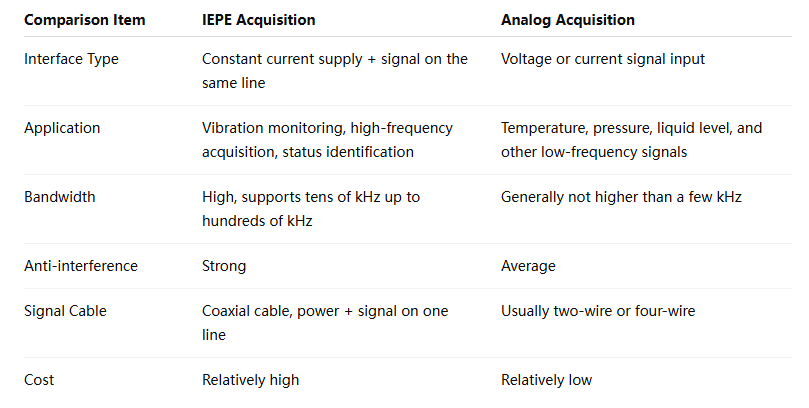
Application Example: Why Did BLIIoT Launch an IEPE Acquisition Module?
BLIIoT continues to innovate in industrial control and edge computing. To address industrial customers’ needs for high-precision data acquisition in equipment vibration monitoring, motor anomaly detection, and structural health analysis, BLIIoT recently launched its IEPE expansion module.
Module features include:
-
4-channel IEPE input
-
Sampling rate up to 144 KS/s
-
Seamless integration with the ARMxy series controllers, enabling local intelligent processing + cloud connectivity
This module bridges ARM-based controllers with high-speed IEPE acquisition, empowering industrial equipment to transition from reactive maintenance to predictive maintenance.


