EdgePLC industrial edge AI controller integrates a 6TOPS NPU, CODESYS deterministic control, IEC 61499 event-driven scheduling, and YOLO vision inference on one device. It enables millisecond-level "inspect-decide-execute" closed loops for industrial quality inspection, reducing end-to-end latency from 50ms to 8ms and replacing the traditional "industrial PC + PLC + industrial PC" architecture.
EdgePLC is an industrial edge AI controller from Beilai Tech that integrates a 6TOPS NPU, CODESYS deterministic control, IEC 61499 event-driven scheduling, and YOLO vision inference on a single device. It enables millisecond-level "inspect-decide-execute" closed loops for industrial quality inspection, reducing end-to-end latency from 50ms to 8ms while replacing the traditional "industrial PC + PLC + industrial PC" three-tier architecture.
I. The Real Dilemma of Edge AI: The Model Runs, but Control Cannot Connect
There is a repeatedly validated rule in industrial AI deployment: model accuracy is not the bottleneck—system integration is.
A YOLO model that achieves 0.95 mAP in the lab often gets stuck in three places on the production line:
-
Latency from cross-device communication. Inference results must be sent to the PLC through communication cables, and then the PLC executes the action. The latency in between turns "real-time inspection" into "after-the-fact alarm."
-
Two independent software stacks. The vision system and the control system are separate. Vision engineers and PLC engineers each modify their own side, and joint debugging takes weeks.
-
High cost of trial and error. Once the production line needs to adjust inspection logic or control timing, both systems must be redeployed.
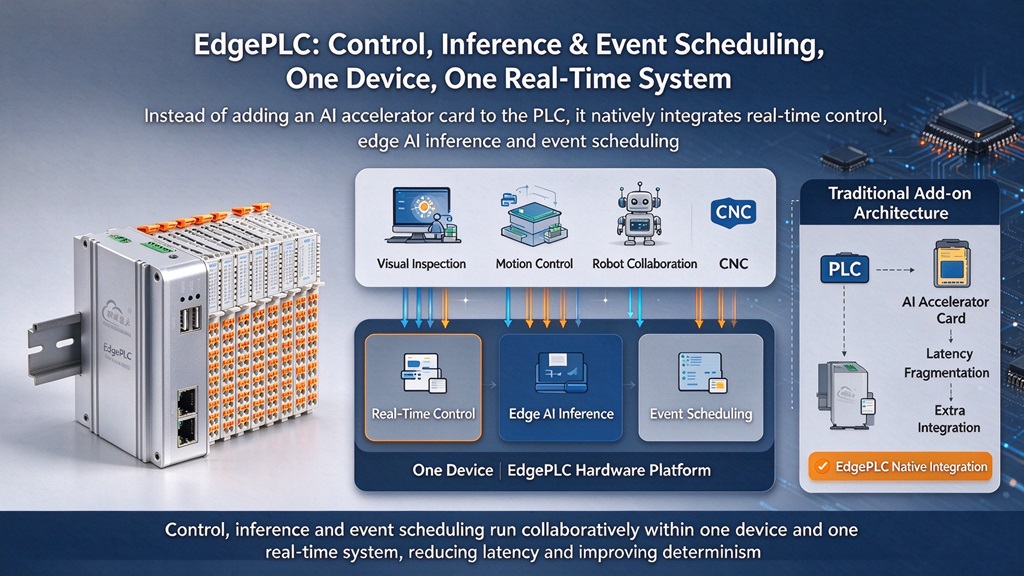
The design of EdgePLC directly targets these three pain points. Its core idea is not "adding an AI acceleration card to a PLC," but putting control, inference, and event scheduling into the same device and the same real-time system.
II. Hardware Foundation: 6TOPS NPU + Heterogeneous Octa-Core
EdgePLC is powered by the Rockchip RK3588J/RK3588 processor (8nm process). Key hardware specifications include:
Why this matters: Different types of tasks can truly run "in parallel" without competing for resources. The A76 cores handle CODESYS heavy computing tasks, the A55 cores handle data acquisition and communication, the NPU is dedicated to YOLO inference, and the Cortex-M0 coprocessors guarantee time-critical I/O response.
Measured performance:
For the production line takt of the vast majority of industrial quality inspection scenarios, this performance range is already sufficient. EdgePLC is a controller and also a visual computing platform.
III. Three Software Paths Working Together on One Device
EdgePLC's edge AI practice is built on the layered collaboration of three software paths.
Path 1: CODESYS — The Deterministic Execution Layer
What it does: CODESYS Runtime runs on EdgePLC's Ubuntu 20.04 + Linux-RT real-time kernel and handles logic control, motion control, and EtherCAT master communication under the IEC 61131-3 standard.
Key capability: By running CODESYS PLC Runtime on CPU-isolated cores, the EtherCAT cycle can reach the 250μs level. Control execution determinism is not disturbed by AI inference load—YOLO runs on the NPU, CODESYS runs on the isolated core, and the two exchange data through shared memory rather than external communication.
Functional editions supported: PRO (basic logic control), SM (SoftMotion multi-axis synchronization), CR (CNC+Robotics kinematics)—covering everything from simple rejection control to robot vision guidance.
Path 2: IEC 61499 — The Event-Driven Scheduling Layer
What it does: If CODESYS solves "how to control," IEC 61499 solves "when to do it."
Key difference from traditional PLCs: Traditional PLCs use a cyclic scan model, and vision inspection results must wait for the next scan cycle before being read by the control logic. IEC 61499's event-driven model is different: the completion of visual inference is itself an event that directly triggers downstream function block execution without waiting for a fixed cycle.
Real-world validation: In the actual case of a steel rolling machine flexible production line, process control is programmed with IEC 61499, and the AI defect detection algorithm is implemented in C++/Python. The two work together in the same system—IEC 61499 is responsible for "when to trigger inspection and how inspection results drive production line actions," while the AI algorithm is responsible for "the inspection itself."
On EdgePLC: The YOLO inference completion signal can directly serve as the input event of an IEC 61499 function block, triggering rejection, sorting, or alarm logic. From "inference completion" to "control action," there is no waiting for a scan cycle and no cross-device protocol conversion.
Path 3: YOLO — The Visual Perception Layer
What it does: EdgePLC pre-integrates the complete AI vision stack of YOLOv5/8 + OpenCV. Industrial cameras are connected via USB 3.1 (5Gbps), and YOLO models run local inference on the 6TOPS NPU.
Deployment toolchain: RKNN toolchain supports conversion and INT8 quantization deployment of ONNX/PyTorch models.
Performance for common tasks: For defect detection, target localization, and classification tasks, YOLOv5s/YOLOv8s-level models achieve 25–30ms single-frame inference on EdgePLC, meeting the takt requirements of the vast majority of production lines.
IV. Practical Case: The "Inspect—Decide—Execute" Loop on a Filling Production Line
This section illustrates how the three paths collaborate in a real application architecture.
Scenario Requirements
A filling production line needs to simultaneously complete:
Critical constraint: Inspection results must drive the rejection mechanism at millisecond level, while the production line control logic (filling valve opening, conveyor takt, multi-station interlocking) must not be affected by AI inference load.
Hardware Deployment
Software Division of Labor
Key Value: Latency Reduction
EdgePLC compresses the chain into a single device: inference completion directly triggers an event, and the event directly drives the control output. The latency drops from "communication + scan cycle" to "event propagation + function call." A single device replaces the three-tier architecture of "industrial PC + PLC + industrial PC."
V. Why EdgePLC?—The Complete Closed Loop for Edge AI Deployment
Edge AI deployment does not need a single-point breakthrough of "a stronger NPU" or "a faster PLC," but a complete closed loop from perception to execution. EdgePLC's irreplaceability lies in four characteristics:
1. Physical isolation between computing and control.
The 6TOPS NPU and A76/A55 cores handle inference and computing, while the Cortex-M0 coprocessors and CPU-isolated cores guarantee control determinism—the two do not interfere with each other on the same device.
2. Native collaboration of three software paths.
CODESYS (IEC 61131-3) provides deterministic execution, IEC 61499 provides event-driven scheduling, and YOLO provides visual perception—not a patchwork of three systems, but layered collaboration on the same device.
3. An open foundation with hardware-software decoupling.
The combination of Ubuntu + Linux-RT + CODESYS Runtime ensures control logic is not locked to specific hardware; SOM modular design allows computing power to be upgraded on demand without rewriting control programs.
4. Industrial-grade physical form factor.
-40~85℃ wide temperature, EMC Level 3 protection, independent hardware watchdog, DIN35 rail mounting—edge AI cannot be "an industrial PC placed outside the control cabinet"; it must be part of the production line.
VI. Frequently Asked Questions (FAQ)
Q1: What is EdgePLC?
A: EdgePLC is an industrial edge AI controller from Beilai Tech, powered by the Rockchip RK3588J/RK3588 processor with a 6TOPS NPU, 4×Cortex-A76 + 4×Cortex-A55 CPU, and 3×Cortex-M0 real-time coprocessors. It integrates CODESYS deterministic control, IEC 61499 event-driven scheduling, and YOLO vision inference on a single device.
Q2: How does EdgePLC reduce latency compared to traditional architectures?
A: Traditional architectures require vision IPC → Modbus TCP → PLC → next scan cycle, resulting in tens of milliseconds of latency. EdgePLC compresses this into a single device: YOLO inference completion directly triggers an IEC 61499 event, which directly drives CODESYS control output. Measured latency is reduced from 50ms to 8ms.
Q3: Can AI inference load affect control determinism on EdgePLC?
A: No. CODESYS Runtime runs on CPU-isolated cores with EtherCAT cycles at the 250μs level. YOLO runs on the NPU. The two exchange data through shared memory rather than external communication, so AI inference load does not interfere with control determinism.
Q4: What I/O and expansion capabilities does EdgePLC support?
A: EdgePLC supports up to 32 N-series distributed I/O modules covering DI, DO, AI, AO, RTD, TC, and PWM, plus HDMI 2.1 (4K@120fps/8K@60fps) display output and NVMe M.2 storage expansion.
Q5: What CODESYS editions are available on EdgePLC?
A: CODESYS on EdgePLC supports PRO (basic logic control), SM (SoftMotion multi-axis synchronization), and CR (CNC+Robotics kinematics), covering the full range from simple rejection control to robot vision guidance.
VII. Conclusion
Edge AI deployment ultimately does not depend on a larger model, but on enabling the model's output to become physical-world actions in a deterministic manner and within deterministic time. EdgePLC, with the three-layer collaboration of CODESYS, IEC 61499, and YOLO, is making this closed loop a reality.