Enhance factory quality control using BLIIOT BL450 edge AI computer powered by YOLO for real-time defect and label inspection.
Case Details
In modern manufacturing, quality control is shifting from manual checks to automated machine vision. Leveraging deep learning, factories can now identify product defects in real time, ensuring efficiency, consistency, and traceability.
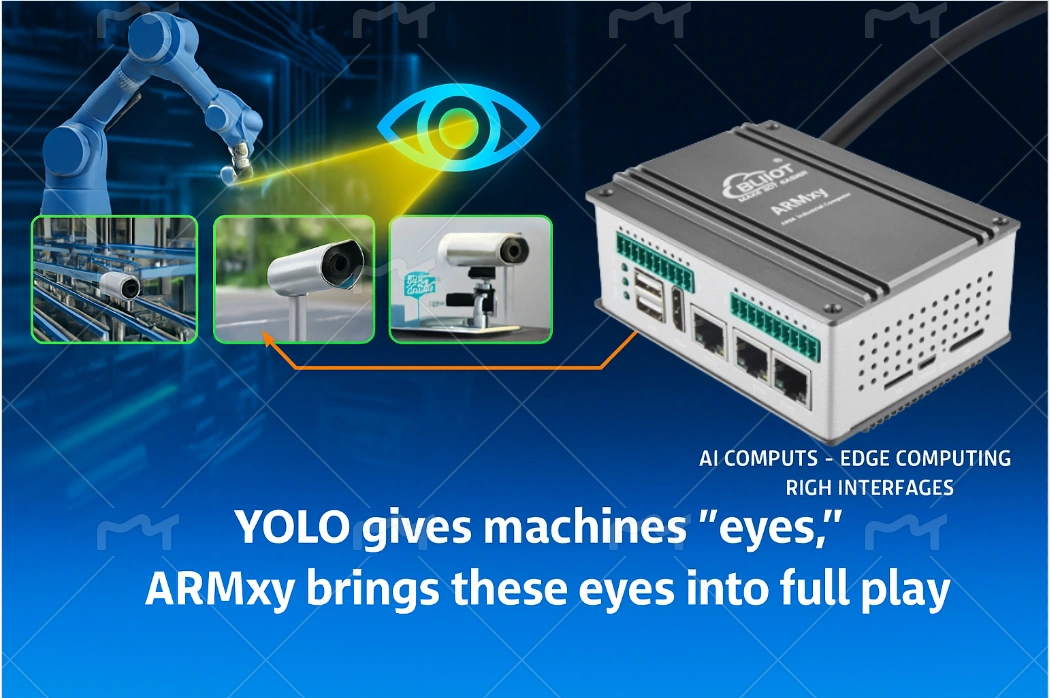
One of the most powerful combinations for this transformation is the BLIIOT BL450 Industrial AI Edge Computer running YOLO (You Only Look Once) — a state-of-the-art object detection algorithm. Together, they bring high-speed, high-accuracy visual inspection directly to the production line.
1. Hardware Foundation — BL450 Industrial AI Edge Computer
At the heart of this solution lies the BL450, powered by the Rockchip RK3588J/RK3588 processor.
-
CPU: 8-core ARM architecture (4×Cortex-A76 + 4×Cortex-A55, up to 2.4 GHz)
-
NPU: 6 TOPS AI accelerator for deep learning inference
-
Memory & Storage: Up to 16 GB RAM and 128 GB eMMC
-
Industrial Interfaces: RS232/485, CAN, DI/DO, GPIO, and LAN ports
-
Design: Fanless, wide-temperature (-40 °C – 85 °C), and DIN-rail mountable
These specifications make BL450 ideal for edge AI computing in harsh factory environments, enabling local inference and decision-making without cloud latency.
2. Application Scenario — Automated Bottle Inspection
A typical use case is bottle quality inspection on a high-speed filling and labeling line.
The challenges:
-
Ensuring every bottle is filled to the correct liquid level
-
Detecting missing or misaligned labels
-
Identifying cracks, dirt, or deformation in containers
Traditionally, these checks rely on human operators or basic sensors — both prone to fatigue and false detections. BL450 + YOLO enables real-time, intelligent, and automated inspection.
3. System Architecture
The inspection system built around BL450 follows a streamlined edge-AI pipeline:
-
Image Capture:
An industrial camera captures continuous images of bottles as they move along the conveyor.
-
Pre-Processing:
The BL450 adjusts lighting, corrects lens distortion, crops the region of interest, and normalizes color.
-
Inference (YOLO Detection):
The optimized YOLO model runs on the BL450’s NPU to detect objects such as:
-
Decision & Control:
Based on inference results, the BL450 instantly triggers actions through its I/O ports — such as:
-
Activating a pneumatic rejector for defective bottles
-
Lighting a warning indicator
-
Logging data for traceability
-
Data Upload & Management:
Inspection results and images can be transmitted via Ethernet or MQTT to MES/SCADA systems for centralized monitoring and analytics.
4. Software Framework
The BL450 runs on industrial Linux/Ubuntu, providing a flexible environment for AI deployment.
Typical software stack:
-
Operating System: Embedded Linux / Ubuntu
-
AI Frameworks: ONNX Runtime, TensorRT, or RKNN Toolkit (optimized for RK3588 NPU)
-
Libraries: OpenCV for image processing
-
Communication: Modbus, MQTT, or custom APIs for factory integration
-
Remote Management: Supported by BLIIOT QuickConfig and BLIoTLink for remote setup and diagnostics
This combination allows engineers to develop and deploy AI applications rapidly while ensuring industrial reliability.
5. Model Training and Optimization
To achieve high accuracy, the YOLO model must be trained or fine-tuned for the factory’s specific environment.
Training Workflow:
-
Data Collection: Capture images of bottles under real production conditions — including correct and defective examples.
-
Annotation: Label defects such as low fill level, missing labels, or cracked bottles.
-
Training: Start with pre-trained YOLO weights and fine-tune them on the custom dataset.
-
Optimization: Quantize and prune the model to reduce size and latency, converting it to RKNN or ONNX format for NPU acceleration.
-
Deployment: Deploy the model to the BL450, validate real-time inference speed, accuracy, and reliability on-site.
This process ensures the vision system can adapt to variations in lighting, bottle shape, and label design while maintaining consistent performance.
6. Real-World Benefits
By implementing BL450 + YOLO, factories achieve:
✅ Real-time detection at line speed — minimal delay between inspection and action
✅ High precision — reduced false rejects and missed defects
✅ Improved efficiency — operators focus on higher-value tasks
✅ Data traceability — every defect and batch is recorded for quality analysis
✅ Scalability — same system can adapt to new bottle types or other visual inspection tasks
7. Beyond Bottles — Expanding Applications
The same architecture applies to other quality inspection tasks:
-
PCB defect detection
-
Package sealing verification
-
Label code recognition and OCR
-
Assembly part alignment
-
Foreign object detection in food or beverages
The BL450’s combination of industrial durability, AI acceleration, and flexible I/O makes it a powerful platform for smart factory automation and visual quality control.
Conclusion
The partnership between BLIIOT BL450 Industrial Edge Computer and YOLO object detection demonstrates how AI is redefining factory quality assurance.
By bringing deep learning directly to the production floor, manufacturers can achieve smarter, faster, and more reliable inspection systems — a key step toward Industry 4.0.


