For precision manufacturing, engineers need to identify the exact shape of a component, extract its boundaries, locate abnormal surface regions and measure dimensional variations. This is where Meta's Segment Anything Model 2 (SAM 2) introduces new possibilities for industrial edge AI.
Case Details
1. What Is SAM 2?
SAM 2 (Segment Anything Model 2), developed by Meta AI, is a foundation model designed for promptable image and video segmentation.
Unlike conventional object detection models that primarily identify objects using bounding boxes, SAM 2 generates pixel-level segmentation masks.
Its key capabilities include:
- Precise object boundary extraction
- Pixel-level region segmentation
- Multiple object segmentation
- Video object tracking across consecutive frames
- Interactive segmentation using points, boxes or masks
One particularly interesting feature is its video memory mechanism.
After an object is selected in an initial frame, SAM 2 can propagate its segmentation across subsequent frames, maintaining object identity even when partial occlusion occurs.
This makes SAM 2 useful for industrial inspection involving moving products and continuous production lines.
2. Why NVIDIA CUDA Matters
SAM 2 is based on a transformer architecture involving image encoding, feature extraction and memory-related computation.
NVIDIA CUDA provides GPU acceleration for these computational tasks.
Combined with the Jetson Orin Nano platform, developers can build local AI segmentation applications without relying on a remote GPU server.
Key technologies include:
CUDA Accelerates parallel GPU operations during model inference.
PyTorch with CUDA Provides the development and execution environment for SAM 2.
FP16 / Mixed Precision Helps reduce memory consumption and improve inference efficiency when supported by the model and software configuration.
TensorRT Offers additional model optimization opportunities, subject to operator compatibility and conversion validation.
The objective is simple: process images locally, reduce unnecessary cloud communication and deliver inspection results closer to the production equipment.
3. Why BEILAI EA230Pro?
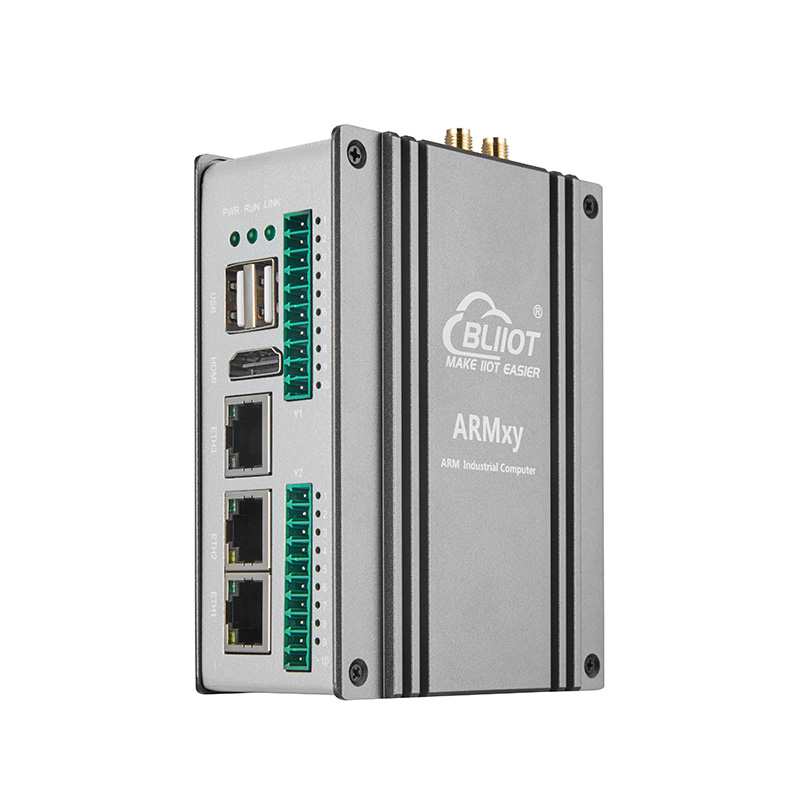
For industrial vision applications requiring multiple cameras and local AI inference, BEILAI EA230Pro provides a compact industrial computing platform.
Powered by NVIDIA Jetson Orin Nano, EA230Pro combines GPU computing with flexible camera connectivity and industrial interfaces.
Key specifications:
- NVIDIA Jetson Orin Nano platform
- Up to 67 TOPS INT8 AI performance (8GB version)
- 1024 CUDA Cores
- 32 fourth-generation Tensor Cores
- 4GB / 8GB LPDDR5 memory
- Four-camera interface configuration options
- 4 × Gigabit Ethernet, GMSL2 or MIPI CSI-2 options
- Y-Series modular industrial I/O expansion
- 12–24V DC input
- Operating temperature: -20°C to +75°C
This combination makes EA230Pro suitable for machine vision equipment, automated inspection stations and multi-camera edge AI applications.
4. Practical Application: Precision Metal Part Inspection
Let's consider an automated inspection station for machined aluminum housings and steel gears.
The production line needs to identify component boundaries, locate suspicious surface regions and measure dimensional variations.
A possible SAM 2-based workflow is:
Step 1 – Image Acquisition
Industrial cameras capture high-resolution images under controlled lighting conditions.
EA230Pro receives the image streams through its selected camera interface.
Step 2 – AI Object Segmentation
SAM 2 receives an initial prompt, such as a positive point or bounding box, to identify the target component.
The model generates a segmentation mask separating the component from its background.
The result provides a more detailed representation than a conventional bounding box.
Step 3 – Defect Region Analysis
The extracted component region is passed to additional image-processing algorithms or defect-detection models.
Potential inspection targets include:
- Surface scratches
- Small dents and pits
- Burrs and irregular edges
- Missing material
- Abnormal surface regions
Importantly, SAM 2 provides segmentation rather than automatic defect classification. Additional inspection algorithms are required to determine whether an identified region represents an actual manufacturing defect.
Step 4 – Dimensional Measurement
Based on the extracted masks, the system can calculate:
- Component area and perimeter
- Hole diameter
- Edge deviation
- Defect region area
- Geometric differences from reference dimensions
With camera calibration, lens distortion correction and pixel-to-millimeter conversion, the system can support physical dimensional measurements.
Step 5 – Industrial Equipment Integration
Inspection results are transmitted to the production control system.
Based on the inspection decision, the system can trigger:
- Product rejection
- Sorting mechanisms
- Inspection alarms
- Quality data recording
EA230Pro's Y-Series expansion provides additional industrial interfaces for connecting external equipment.
5. From Image Segmentation to Video Tracking
SAM 2 also introduces an interesting capability for continuous production lines.
Imagine a metal component moving along a conveyor belt.
- An industrial camera captures the component in the first frame.
- SAM 2 identifies its boundaries using an initial prompt.
- The segmentation mask is propagated across subsequent frames.
- The system maintains the object's segmentation as it moves.
- Inspection results can be associated with the corresponding production item.
This approach can reduce repeated manual prompting and support more consistent object tracking during video analysis.
For applications requiring high-speed production inspection, camera frame rate, image resolution and inference latency must be evaluated together.
6. Deployment Architecture with EA230Pro
A typical industrial edge AI architecture can be organized as follows:
Industrial Cameras ↓ BEILAI EA230Pro – NVIDIA Jetson Orin Nano ↓ NVIDIA CUDA + PyTorch + SAM 2 ↓ Object Segmentation + Defect Analysis ↓ Dimensional Measurement ↓ PLC / Industrial I/O / SCADA ↓ Production Control & Quality Management
AI inference and visual analysis run locally on EA230Pro.
The PLC remains responsible for deterministic machine control, production sequencing and safety-related logic.
This separation allows AI vision to complement existing industrial automation systems.
7. What Value Does It Bring to Machine Builders?
For machine manufacturers and system integrators, SAM 2 introduces a more flexible approach to industrial visual inspection.
Combined with EA230Pro, it provides a foundation for:
- Precise object boundary extraction
- Flexible inspection of different product geometries
- Video-based object segmentation
- Local AI inference without continuous cloud dependency
- Integration with existing industrial control systems
- Expandable camera and industrial I/O configurations
The actual performance depends on the selected SAM 2 model size, image resolution, camera configuration, available memory and software optimization.
AI vision is moving beyond detecting objects. It is moving toward understanding every pixel that matters.
BEILAI EA230Pro + NVIDIA Jetson Orin Nano: Bringing advanced AI segmentation closer to industrial production.
Explore EA230Pro: https://sale.bliiot.com/products/nvidia%C2%AE-jetson-orin%E2%84%A2-nano-edge-ai-computer-ea230pro
#BEILAI #BLIIOT #NVIDIAJetson #JetsonOrinNano #CUDA #SAM2 #SegmentAnything #EdgeAI #MachineVision #IndustrialAI #SmartManufacturing