Node-RED industrial gateways provide an open, flexible, and intelligent edge solution for water treatment systems. They effectively address multi-protocol access and remote communication challenges while significantly improving maintainability and scalability through edge computing and visual configuration.
Case Details
As smart water management and industrial digitization continue to advance, traditional water treatment systems face urgent upgrade challenges. From water supply plants and sewage treatment facilities to industrial wastewater stations, the large number of on-site devices, complex protocols, and dispersed locations make the conventional PLC + HMI architecture increasingly inadequate in terms of system flexibility, remote maintenance, and data value extraction.
In this context, Node-RED-based industrial gateways are emerging as key edge nodes connecting field devices to upper-layer platforms, delivering more flexible, efficient, and intelligent solutions for water treatment systems.
Typical Requirements and Pain Points in Water Treatment Systems
The water treatment industry has distinct characteristics, with main pain points including:
- Diverse Device Types: Pumps, valves, PLCs, flow meters, level gauges, pressure transmitters, pH/ORP sensors, etc.
- Complex Communication Protocols: Coexistence of Modbus RTU/TCP, OPC UA, 4–20mA, DI/DO, and others.
- Wide Site Distribution and High Maintenance Costs: Most pumping and sewage stations are unmanned or minimally staffed.
- Low Data Utilization: Data used only for display, lacking edge analysis and intelligent linkage.
- Long Upgrade Cycles: High cost and time for PLC program modifications and expansions.
These issues drive the transition from "pure automation" to "automation + informatization + intelligence."
System Positioning of Node-RED Industrial Gateway
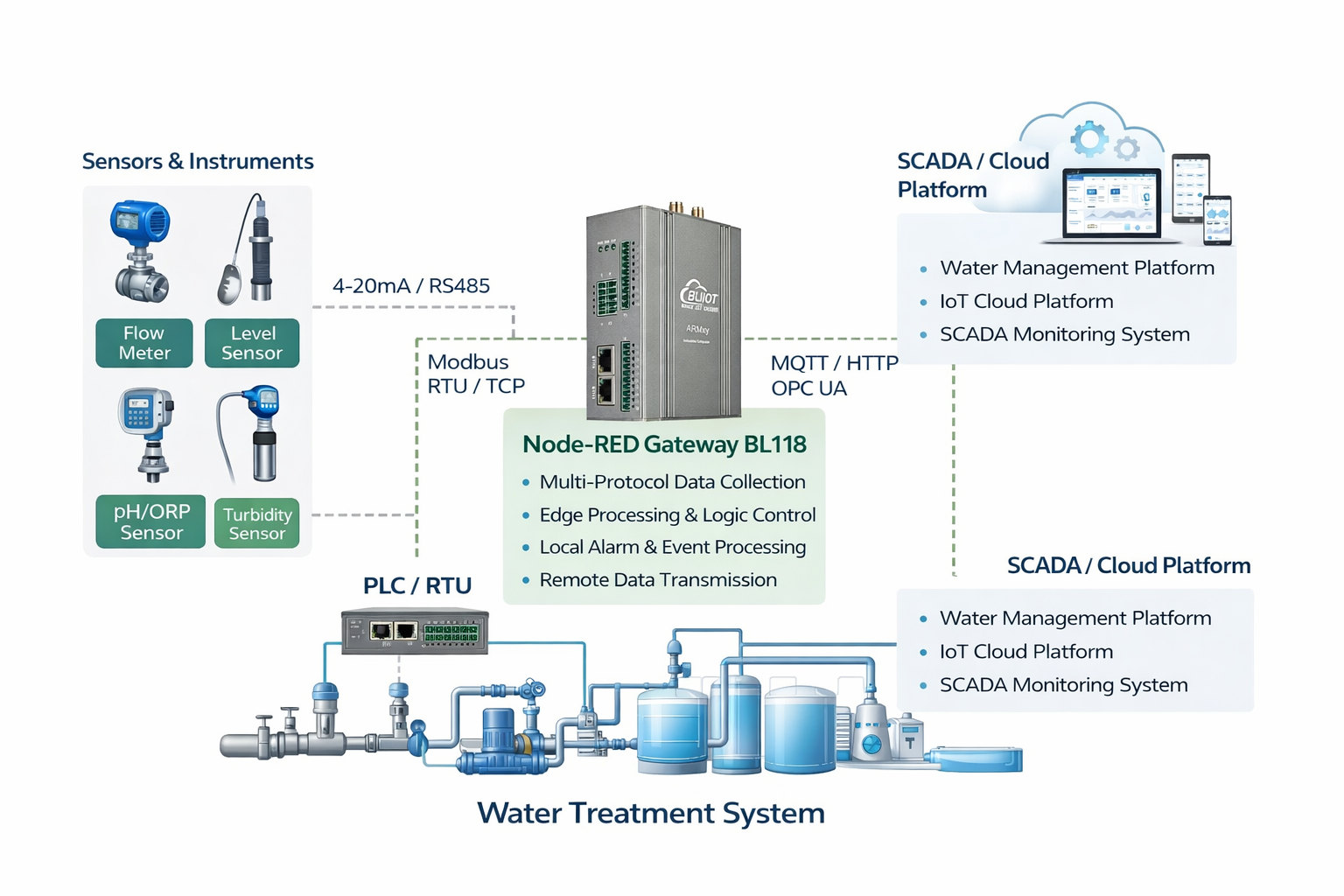
Node-RED industrial gateways are typically deployed between the field control layer and management platforms, positioned as the edge data and logic processing center for water treatment systems. It serves not only as a communication gateway but also as an intelligent node with edge computing and logic capabilities.
In typical architectures:
- Downstream Connections: PLCs, RTUs, instruments, sensors.
- Upstream Connections: SCADA systems, water management platforms, IoT cloud platforms.
Core Functions of Node-RED in Water Treatment
- Multi-Protocol Data Acquisition and Integration Leveraging Node-RED's rich node ecosystem, it easily achieves:
- Modbus RTU/TCP data acquisition (pumps, valves, PLCs).
- OPC UA device integration (large-scale water plant systems).
- Analog/digital signal reading (flow, level, pressure).
- HTTP/MQTT interactions with third-party systems. Seamless integration of heterogeneous device data without complex programming.
- Edge-Side Logic Control and Linkage Local implementation of control logic, such as:
- Pump start/stop based on high/low levels.
- Automatic alarms for flow anomalies.
- Dosing equipment linkage on pH exceedance.
- Multi-condition judgments (level + time + flow). Reduces frequent PLC modifications and enhances overall flexibility.
- Alarm Management and Event Handling Supports:
- Threshold alarms (level, pressure, pH, etc.).
- Local audible/visual alarms.
- MQTT/HTTP pushes to platforms.
- Local caching during network interruptions, with automatic retransmission upon recovery.
- Event and alarm logging. Ideal for unmanned pumping stations and distributed sewage treatment.
- Edge Computing and Data Optimization Processes raw data at the edge:
- Filtering, aggregation, compression.
- Uploading only key data and anomalies. Reduces traffic and eases cloud burden, especially for large-scale water systems.
- Visualization and Remote Maintenance Built-in web features enable:
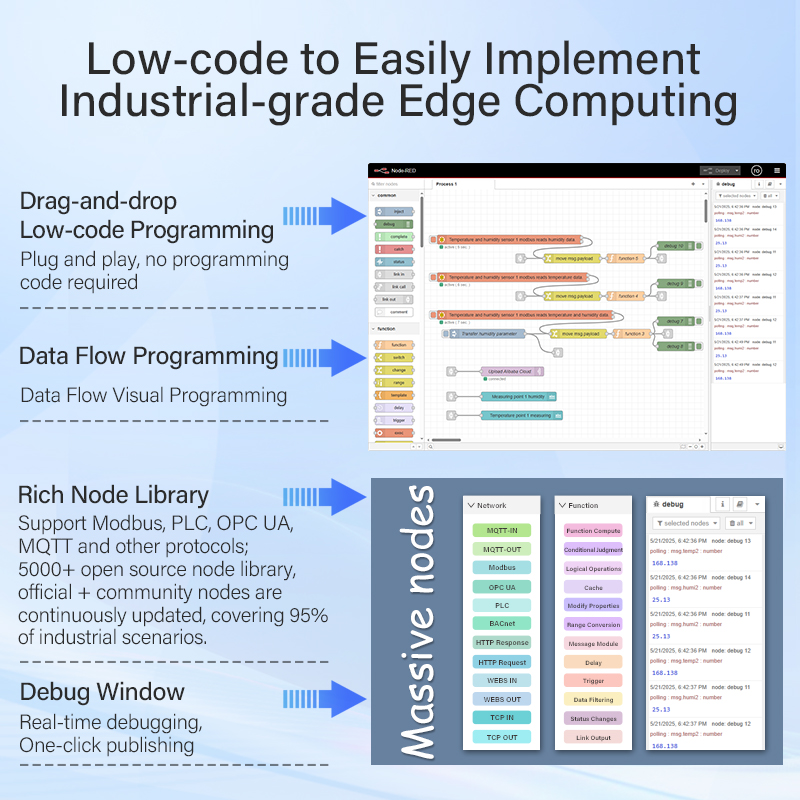
- Visual flow configuration.
- Web Dashboard for data display.
- Remote maintenance and logic adjustments.
- Rapid replication across sites. Suited for quick deployment in small/medium water plants or regional projects.
Typical Application Scenarios
Node-RED industrial gateways apply to scenarios such as:
- Water intake, pressurization, and distribution in supply plants.
- Inflow, aeration, sedimentation, and discharge monitoring in sewage plants.
- Centralized wastewater treatment in industrial parks.
- Decentralized rural sewage stations.
- Remote monitoring of secondary water supply pump rooms.
- Unmanned rainwater/sewage pumping stations.
Advantages Over Traditional Solutions
| Comparison Dimension |
Traditional (PLC + HMI) |
Node-RED Industrial Gateway BL118 |
| Development Method |
Primarily programming |
Low-code, visual drag-and-drop |
| Protocol Extension |
High cost, long cycle |
Rich nodes, easy expansion |
| Cloud Integration |
Complex |
Native MQTT/HTTP support |
| System Flexibility |
Moderate |
High (easy edge logic adjustments) |
| Suitable Scenarios |
Fixed processes |
Distributed, rapid deployment and iteration |
Conclusion
Node-RED industrial gateways provide an open, flexible, and intelligent edge solution for water treatment systems. They effectively address multi-protocol access and remote communication challenges while significantly improving maintainability and scalability through edge computing and visual configuration.
Amid the rise of smart water management, unmanned stations, and digital upgrades in water treatment, Node-RED gateways are becoming an indispensable component, driving the industry toward greater efficiency and sustainability.


