In the future of manufacturing, these ARM Embedded AI Controllers will drive factories from simple “automated operation” to true “autonomous decision-making”, ultimately realizing the vision of lights-out factories and smart manufacturing.
Case Details
As manufacturing continues to evolve toward digitalization, intelligence, and unmanned operations, the "lights-out factory" (also known as dark factory) has emerged as a key direction in advanced manufacturing. The core objective of a lights-out factory is to achieve fully automated processes in production, inspection, logistics, and management with minimal or no human intervention, enabling stable and efficient operation even in complete darkness.
Traditional PLCs or centralized industrial servers alone can no longer meet these demands. ARM-based embedded AI controllers, with their edge computing and artificial intelligence capabilities, are becoming essential technical enablers for lights-out factories.
- Low Power Consumption and High Stability for 24/7 Operation The ARM architecture inherently offers low power efficiency, making it ideal for industrial scenarios requiring continuous operation. In lights-out factories, equipment must run uninterrupted year-round. ARM embedded AI controllers significantly reduce energy use, minimize heat dissipation and maintenance needs, and enhance overall system reliability.
- Native Support for Edge AI Computing Modern ARM industrial controllers often integrate NPUs, GPUs, or AI acceleration units, supporting mainstream AI inference frameworks. They enable local processing of tasks such as:
- Machine vision recognition
- Anomaly detection
- Behavior and trend analysis This eliminates the need to upload large volumes of raw data to the cloud, delivering low-latency and highly reliable intelligent decisions.
- Industrial-Grade Reliability Design Tailored for harsh lights-out factory environments, these controllers typically feature:
- Wide temperature range operation
- Shock and electromagnetic interference resistance
- Fanless design with industrial-grade components They ensure long-term stable performance in high-dust, high-humidity, or high-interference conditions.
- Rich Industrial Communication Interfaces ARM embedded AI controllers support multiple industrial buses and protocols, including:
- EtherCAT
- Modbus TCP/RTU
- CAN/CANopen
- PROFINET
- OPC UA This allows seamless integration with sensors, robots, AGVs, production line equipment, and upper-level systems to form a unified intelligent control network.
Core Applications of ARM Embedded AI Controllers in Lights-Out Factories
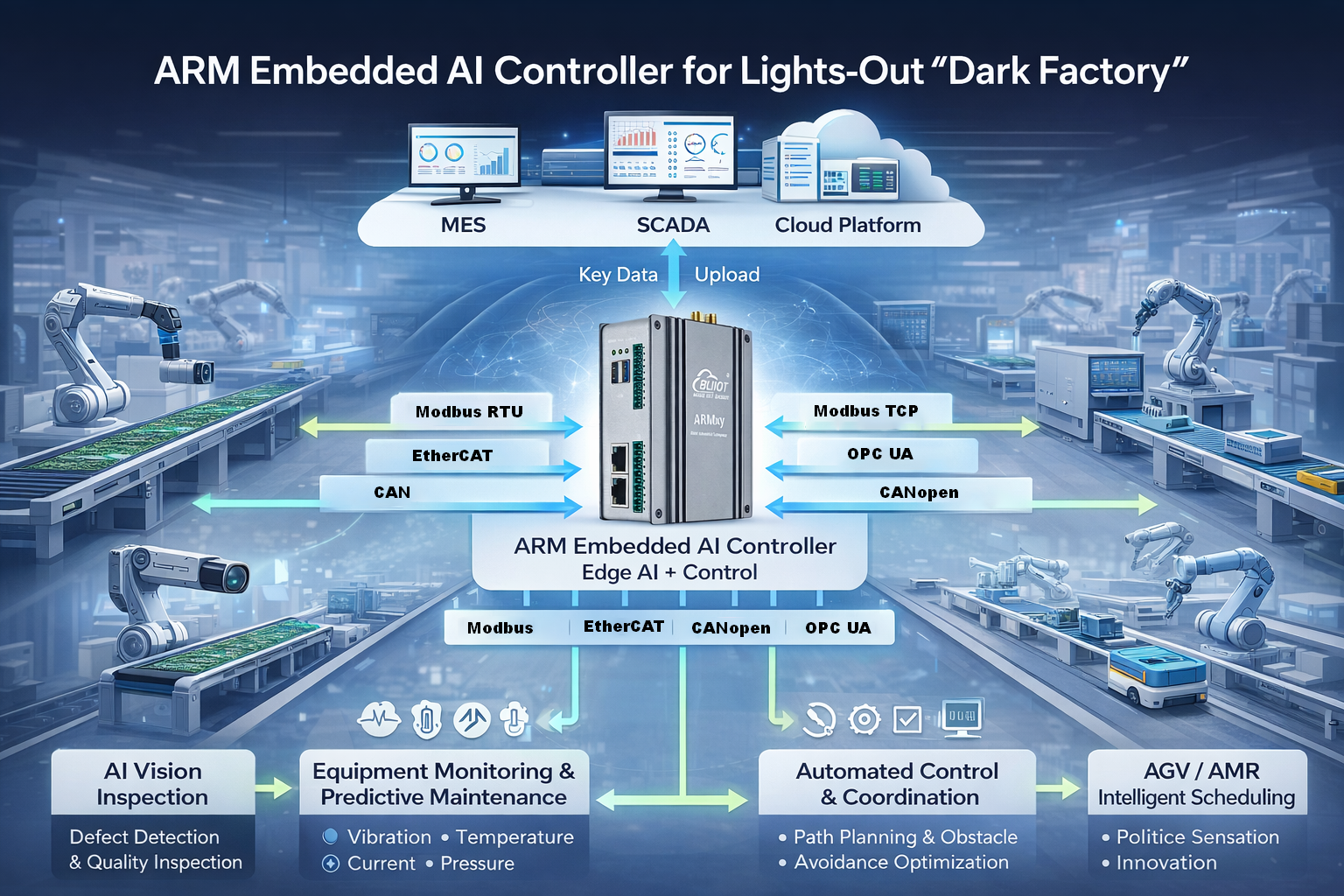
- AI Vision Inspection for Unmanned Quality Control In lights-out factories, traditional manual inspection is replaced by AI vision systems. ARM embedded AI controllers connect directly to industrial cameras for edge-based image capture and AI inference, enabling:
- Product surface defect detection
- Assembly completeness verification
- Dimensional and positional deviation analysis Compared to human inspection, AI vision offers superior consistency, higher efficiency, and immunity to fatigue, serving as a foundational capability.
- Equipment Status Monitoring and Predictive Maintenance By continuously collecting operational data (vibration, current, temperature, pressure, etc.), these controllers perform local intelligent analysis to identify anomalies early, achieving:
- Advance fault warnings
- Automated maintenance scheduling
- Significant reduction in unplanned downtime Predictive maintenance is critical for ensuring uninterrupted operation in lights-out factories.
- Intelligent Production Line Control and Adaptive Optimization Combining AI with real-time control, ARM controllers act as edge cores for production lines, supporting:
- Multi-device coordinated control
- Real-time data analysis
- Adaptive adjustment of process parameters Through AI-driven production state analysis, systems dynamically optimize takt time, yield rates, and energy consumption for advanced intelligent manufacturing.
- AGV/AMR Unmanned Logistics Scheduling Material handling in lights-out factories requires full automation. ARM controllers power AGVs/AMRs for:
- Path planning
- Intelligent obstacle avoidance
- Task scheduling Integration with MES and WMS systems enables automated material delivery and precise management.
- Intelligent Energy and Environmental Management These controllers analyze factory energy and environmental data for:
- Monitoring electricity, gas, and water usage
- Anomaly detection in consumption
- Automatic regulation of temperature and humidity This balances production stability with energy savings and green manufacturing.
Role in Lights-Out Factory System Architecture
In the overall architecture, ARM embedded AI controllers are typically deployed between the device and management layers, serving as:
- Real-time control and edge computing nodes
- Local AI inference and decision centers
- Data aggregation and uplink interfaces
This "edge intelligence + cloud management" hybrid ensures real-time performance while maintaining system scalability.
Conclusion
Lights-out factories represent more than simple unmanned operations; they embody a highly intelligent manufacturing system integrating automation, edge computing, and artificial intelligence.
ARM embedded AI controllers, with their low power consumption, high reliability, robust AI capabilities, and extensive industrial interfaces, are emerging as a critical foundational platform.
In the future of manufacturing, these controllers will drive factories from mere "automated operation" toward true "autonomous decision-making," realizing the ultimate vision of intelligent manufacturing.


