As semiconductor nodes shrink, demands for equipment stability, visualization, and analytics rise. ARM embedded computers offer efficient, scalable solutions with proximate edge computing, industrial reliability, and open architecture.
Case Details
Semiconductor manufacturing is a highly automated, precision-driven industry that operates continuously, demanding exceptional equipment stability and predictability. Critical systems—such as dry vacuum pumps, chillers, cooling water systems, and gas supply networks—must maintain uninterrupted performance during wafer fabrication, packaging, and testing. Any anomaly can reduce production capacity, lower yield rates, or even result in complete batch scrap.
Building a highly reliable, real-time monitoring system with edge intelligence has thus become essential for digital transformation and smart upgrades in semiconductor fabs.
Challenges in Semiconductor Equipment Monitoring
Real-world semiconductor facilities face several persistent issues in equipment monitoring:
- Diverse Equipment and Complex Protocols: Devices from various vendors (e.g., dry pumps, chillers, and sensors) employ multiple communication standards like Modbus, CAN, or proprietary protocols, complicating system integration.
- Stringent Real-Time and Continuity Requirements: 7×24-hour operations mean any monitoring interruption or data loss poses significant risks.
- Slow Response in Traditional Centralized Architectures: Uploading all data to central servers or the cloud introduces delays due to network latency and processing loads.
- High Maintenance Costs: Reliance on manual inspections or post-failure alerts makes it difficult to detect latent faults proactively.
ARM architecture embedded computers excel in stability, flexibility, low power consumption, and industrial-grade reliability, making them an ideal platform for semiconductor equipment monitoring. Industry examples from vendors like Moxa, Advantech, and Beilai highlight their deployment in fabs for edge computing and condition monitoring.
- Rich Interface Integration and Proximity Deployment ARM embedded systems typically feature diverse interfaces (RS485/RS232, CAN, Ethernet, DI/DO, AI), enabling direct connections to dry pumps, motor drives, temperature/pressure sensors, and more. This device-side deployment minimizes intermediaries and streamlines data acquisition.
- Edge Computing for Enhanced Response Speed Local processing of data filtering, threshold checks, and status analysis allows millisecond-level anomaly detection and on-site alerts. This reduces dependency on cloud or central systems, improving safety and aligning with real-time edge solutions used in predictive maintenance.
- Industrial-Grade Reliability for Cleanroom Environments Low power draw, minimal heat generation, fanless designs, wide-temperature operation, and EMI resistance ensure long-term stability inside cleanrooms or equipment cabinets—meeting the rigorous demands of semiconductor fabs.
- Open Software Ecosystem for Seamless Integration Support for Linux, C/C++, Python, and tools like Node-RED facilitates easy connectivity with factory systems (SCADA, MES, EAP, FMCS), providing a scalable computing foundation for digital fabs.
Typical Application Scenarios
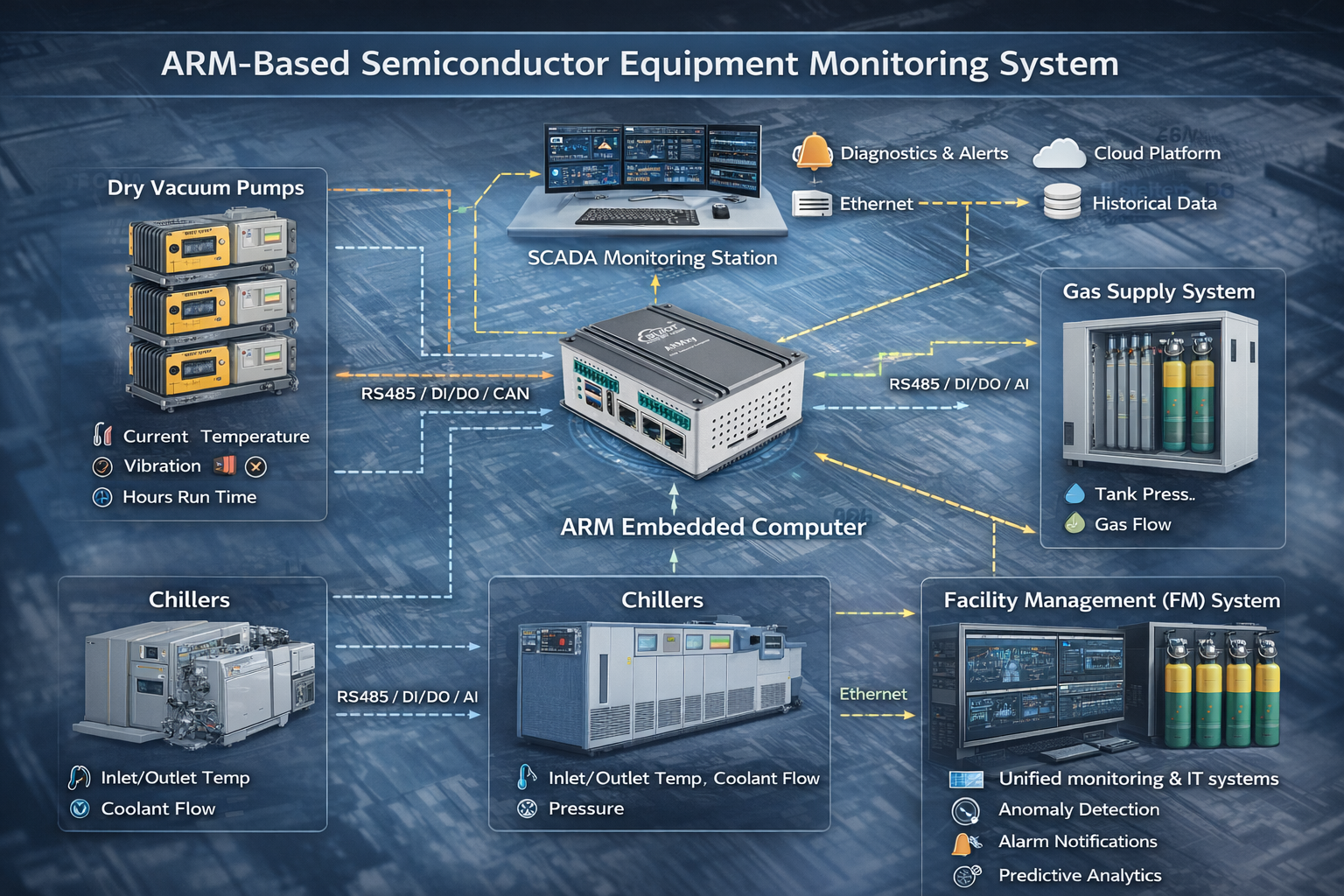
- Dry Vacuum Pump Monitoring Real-time collection of motor current, bearing temperature, runtime, and vibration data enables early detection of wear, blockages, or overloads, preventing sudden downtime—a critical concern given the thousands of dry pumps in modern fabs.
- Chiller and Cooling Water System Monitoring Continuous tracking of inlet/outlet temperatures, flow rates, and pressures maintains thermal stability, avoiding process inconsistencies due to cooling failures.
- Facility System Edge Nodes Aggregating and preprocessing data from multiple devices before uploading reduces load on central servers.
- Predictive Maintenance and Energy Efficiency Analysis Edge-side trend analysis of historical data supports maintenance scheduling and energy optimization.
Driving Semiconductor Manufacturing Toward Intelligence
As process nodes advance, demands for equipment stability, data visualization, and intelligent analysis continue to rise. ARM-based embedded computers offer an efficient, scalable path through proximity-based edge computing, industrial reliability, and open architectures.
In the future, these systems will evolve beyond mere data collection terminals, serving as core enablers for smart operations, predictive maintenance, and digital twins in semiconductor factories.


