In modern commercial buildings, energy efficiency is essential. Using the BLIIOT BL192Pro with Y11, Y21, and Y43 modules, this solution integrates occupancy data, AC status (Modbus RTU), and TOU pricing (Modbus TCP) for real-time lighting/HVAC control. It saves energy during peak tariffs without reducing comfort, while the BL192Pro’s multi-protocol, modular, and robust design suits diverse automation needs.
Case Details
Model Combination: BL192Pro + Y11 + Y21 + Y43
Preface
In modern commercial buildings, energy efficiency is no longer just a cost-saving measure — it is an operational necessity and a key component of sustainable development. Rising electricity prices, especially under time-of-use (TOU) tariff policies, demand that building systems respond intelligently and automatically to changing conditions.
This solution leverages the BLIIOT BL192Pro Edge I/O Module with Y11, Y21, and Y43 expansion units to create an integrated, real-time control strategy for lighting and HVAC systems. By combining data from occupancy sensors, air-conditioning status via Modbus RTU, and live electricity pricing via Modbus TCP, the system can make immediate local decisions to reduce energy usage during peak pricing periods — without impacting occupant comfort.
Beyond this specific application, the BL192Pro’s multi-protocol compatibility, modular I/O design, and robust industrial build make it ideal for a wide range of smart building and industrial automation projects. This plan details not only the core control logic but also demonstrates the flexibility and scalability of the BL192Pro platform for future expansion.
1. System Overview
The BL192Pro MQTT Edge I/O Module acts as the central automation and logic control unit, offering:
- Multiple protocol support — MQTT, Modbus TCP, Modbus RTU — for direct integration with energy management systems, HVAC controllers, and building networks.
- Local logic execution via built-in web programming (no extra PLC needed).
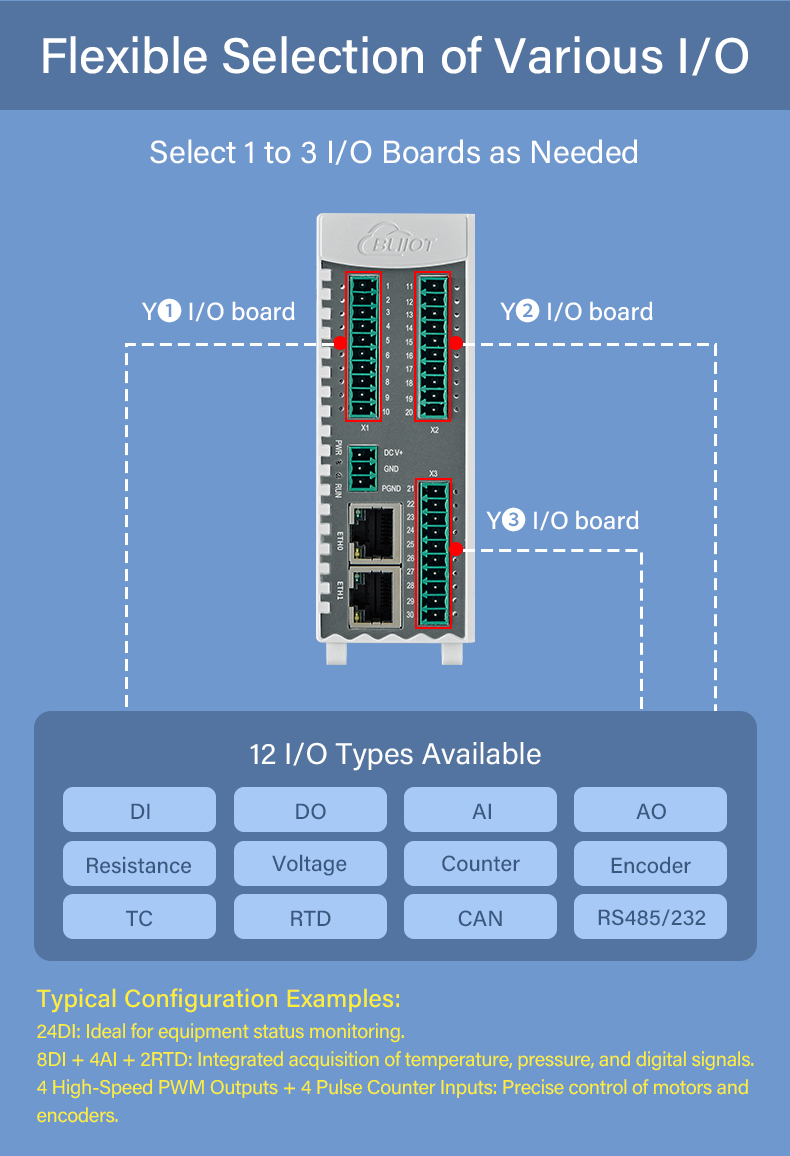
- I/O expansion flexibility with modules like Y11 (digital input), Y21 (digital output), and Y43 (analog output).
- Industrial-grade design (wide temperature range -40 ~ 85 °C, strong EMC resistance) for reliable operation.
- Real-time data exchange with cloud or local systems over LAN/WAN.
2. Application Scenario — Dynamic Peak Tariff Energy Management
Data Sources
- Occupancy sensors → Y11 digital inputs (NPN)
- Air-conditioning status → RS485 Modbus RTU registers
- Time-of-use electricity pricing → Ethernet Modbus TCP from EMS or utility
Control Targets
- Lighting → Y21 PNP digital outputs (switch off circuits)
- HVAC setpoint → Y43 voltage analog outputs (0–5 V or 0–10 V)
Logic Implementation
Logic 1 — Occupancy-based Lighting Control
Condition:
- Electricity price ≥ 0.2 USD (peak tariff)
- AND no occupancy in the area
Action:
- Y21 output deactivates lighting circuits for unoccupied zones
Logic 2 — Peak-Time HVAC Efficiency Mode
Condition:
- Electricity price ≥ 0.2 USD
- AND AC status = Running
- AND outdoor temperature < 20 °C
Action:
- Y43 AO1 outputs 2 V, setting indoor temperature to 25 °C
3. Expected Outcomes
- Energy savings during high-tariff periods
- Automatic demand response without operator intervention
- Improved system longevity from reduced run-times
- Lower operational costs via optimized control
4. Extended Applications of BL192Pro Series
| Application Area |
Example Use Case |
BL192 Role |
| 🏭 Industrial Equipment |
Motor run-time monitoring & predictive maintenance |
Read vibration/temp sensors via DI/AI, trigger DO alerts |
| 🌡 Environmental Monitoring |
Greenhouse climate control |
Acquire temp/humidity, drive fans/irrigation via AO/DO |
| 🚦 Infrastructure |
Smart street lighting |
Use light sensors via DI + Modbus pricing to dim/brighten |
| 🏠 Smart Buildings |
Conference room booking automation |
Integrate occupancy, schedule data, and control lighting/HVAC |
| 📊 Energy Management |
Load shedding during grid stress |
Pull pricing/demand data via Modbus TCP, auto-off noncritical loads |
| 💧 Water/Wastewater |
Pump station automation |
Level sensors via DI, control pumps via DO/AO |
5. Why BL192Pro is Ideal for Multi-Scenario Deployment
- One device, many protocols → simplifies integration with diverse systems
- Modular hardware design → flexible I/O combinations
- Local decision-making → no latency from cloud-only control
- Reliable in harsh environments → suitable for industrial, commercial, or remote applications
- Scalable → easily expanded with additional modules


