This solution addresses the integration needs of small-scale automation control systems (such as smart production lines, building automation, and environmental monitoring) by proposing a holistic approach centered on the BLIIOT BL192Pro versatile Edge I/O module.
Case Details
IT/OT Integration Solution for Small-Scale Automation Control Systems Based on the BL192Pro Edge I/O Module
Abstract: In the context of Industry 4.0 and digital transformation, the deep integration of Information Technology (IT) and Operational Technology (OT) is key to achieving intelligent and flexible production. This solution addresses the integration needs of small-scale automation control systems (such as smart production lines, building automation, and environmental monitoring) by proposing a holistic approach centered on the BLIIOT BL192Pro versatile Edge I/O module. The solution aims to break down data barriers between field device layers and cloud/information layers, enabling secure, real-time, standardized data exchange and edge intelligence control, while significantly reducing system complexity and deployment costs.
1. IT/OT Integration Challenges and Core Requirements
Small-scale automation projects often face the following pain points in IT/OT integration:
-
Protocol Heterogeneity: Field devices (sensors, meters, PLCs) predominantly use OT protocols like Modbus RTU/TCP, while IT systems (cloud platforms, MES, databases) typically use IT protocols like MQTT, HTTP, and OPC UA, creating a "language barrier."
-
High Cost and Complexity: Traditional solutions require combining multiple devices like PLCs (control), I/O modules (acquisition), and protocol gateways (conversion), leading to complex system architecture, cumbersome wiring, and high procurement and maintenance costs.
-
Underutilized Data Value: Field data often remains confined to local monitoring, making it difficult to securely and efficiently upload to cloud platforms for big data analysis and optimization, resulting in "data silos."
-
Difficult Remote Operation and Maintenance: Dispersed equipment lacks secure means for remote configuration, diagnosis, and upgrades, leading to low operational efficiency.
The BL192Pro Edge I/O module is designed precisely to tackle these challenges. It integrates PLC, distributed I/O, and multi-protocol gateway functionalities into a single unit, making it an ideal IT/OT fusion edge node.
2. Solution Core: BL192Pro as the Fusion Hub
The BL192Pro is a compact device integrating data acquisition, protocol conversion, edge computing, and secure communication. Its core advantages perfectly align with integration needs:
-
Native Triple-Protocol Support: Simultaneously natively supports MQTT, Modbus TCP, and OPC UA. This allows it to function as a Modbus TCP slave for local SCADA/DCS systems, an OPC UA server providing standardized data to MES/ERP, and an MQTT client publishing data directly to cloud platforms like AWS IoT or Alibaba Cloud, achieving "three functions in one device."
-
Powerful Data Acquisition and Edge Processing Capability:
-
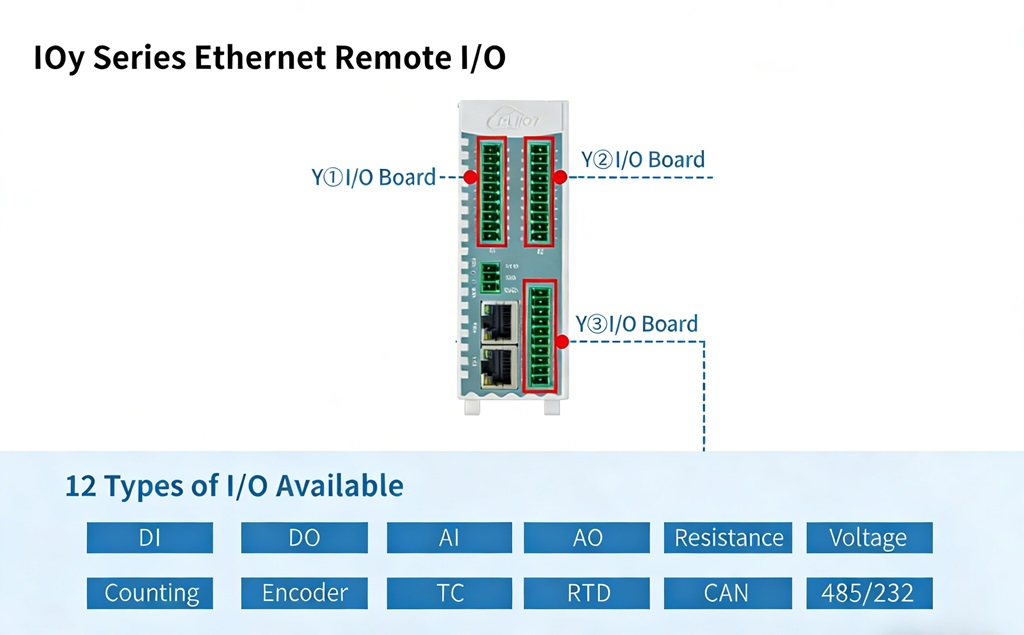
Modular I/O: Supports 1-3 Y-series I/O expansion boards, allowing flexible configuration of various signal types including Digital Input/Output (DI/DO), Analog Input/Output (AI/AO), Resistance Temperature Detector (RTD), and Thermocouple (TC), covering the vast majority of sensors and actuators.
-
Serial Data Integration: Features a built-in isolated RS485 port, which can act as a Modbus RTU master to collect data from serial devices like smart meters, inverters, and temperature/humidity sensors, unifying it into upper-layer IT protocols.
-
Built-in Edge Logic: Through its built-in web server, it enables register read/write and simple local logic control, performing data filtering, alarm judgment, and linkage control at the edge, reducing the burden on the cloud and central controllers.
-
Industrial-Grade Security and Reliability: Complies with the IEC62443 security standard, supporting X.509 certificate authentication, AES-256 encryption, and role-based access control to ensure data transmission security. Dual Ethernet ports support cascading for enhanced network reliability.
-
Significant Cost-Effectiveness and Ease of Use: Compared to the traditional combination of "PLC + I/O + Gateway," it can reduce comprehensive costs by up to 80%. Integrated with the BLRAT remote access tool, it supports secure remote configuration, debugging, and firmware upgrades, greatly simplifying deployment and full lifecycle maintenance.
3. System Architecture and Data Flow Design
The following is a typical IT/OT integration architecture for a small-scale automation system based on the BL192Pro:
Data Flow Explanation:
-
Data Uplink (OT -> IT): The BL192Pro collects data from all field devices via its I/O boards and RS485 port. The data is then preprocessed at the edge and, according to destination requirements, reported in parallel via different protocols:
-
Real-time Monitoring Data → Sent via Modbus TCP to the local SCADA system for HMI display.
-
Production and Management Data → Sent via OPC UA to the MES or ERP system for production information integration.
-
Equipment Status and Alarm Data → Reported via MQTT to the cloud IoT platform, supporting remote viewing via mobile apps and big data analysis.
-
Control Command Downlink (IT -> OT): Control commands (e.g., parameter settings, start/stop commands) issued by the cloud or central control system are sent down via MQTT or OPC UA to the BL192Pro. The module converts these into executable signals for field devices, outputting them via DO or AO channels, or issuing them as Modbus RTU commands via the RS485 port.
4. Example Implementation for a Typical Application Scenario
Scenario: Monitoring and Energy Efficiency Management of an Intelligent Small-Scale Manufacturing Unit
5. Summary of Solution Value
-
Simplified Integration, Breaking Down Silos: One device solves data acquisition, protocol conversion, and edge control, thoroughly bridging IT and OT networks, enabling seamless data flow from sensors to the cloud.
-
Optimal Cost, Rapid Deployment: Significantly reduces hardware costs. Modular design supports flexible configuration, shortening system design, installation, and commissioning cycles.
-
Secure and Reliable, Efficient Operations and Maintenance: Built-in industrial-grade security mechanisms ensure data security. Remote maintenance capabilities greatly reduce the need for on-site service and lower operational costs.
-
Future-Oriented, Flexible Expansion: Supports mainstream open industrial protocols, facilitating future system upgrades and expansions, protecting investment.
6. Selection and Implementation Suggestions
-
Define Requirements: Detail the types (DI/DO/AI/AO, etc.) and quantities of required signal points, as well as the upper-layer systems (SCADA, cloud platform, MES) to interface with and their supported protocols.
-
Module Configuration: Refer to the "Y Series I/O Module Selection" list to choose 1-3 suitable I/O expansion boards for the BL192Pro main unit. For example, requiring 8 digital inputs and 4 analog inputs can be configured as "BL192Pro + Y11 + Y31".
-
Network Planning: Properly plan device network addresses (IP), MQTT Topics, OPC UA namespaces, etc., to ensure network connectivity and correct data routing.
-
Security Configuration: Be sure to enable and configure security features such as X.509 certificates and access passwords during deployment.
Conclusion: For small-scale automation control systems seeking efficient and economical IT/OT integration, the solution centered on the BL192Pro provides a proven and excellent path. It not only solves current data interconnection challenges but also lays a solid foundation for future digital upgrades with its open architecture.


