When integrated into a building's fresh air system, the ARM edge controller not only improves air quality and comfort but also plays a crucial role in energy conservation and safety
Case Details
In today's green and healthy buildings, Indoor Air Quality (IAQ) has become a key factor affecting occupant health, comfort, and building energy consumption. Traditional constant air volume (CAV) fresh air systems can no longer meet dynamic ventilation demands. Intelligent, demand-controlled, energy-efficient fresh air systems are becoming the industry mainstream. In this transformation, ARM edge controllers stand out as the preferred core control platform due to their low power consumption, high reliability, powerful edge computing capabilities, and rich interface support.
Intelligent Requirements of Modern Fresh Air Systems
Modern fresh air systems must achieve:
- Multi-parameter Air Quality Sensing
- Real-time monitoring of CO₂, PM2.5, TVOC, temperature, humidity, formaldehyde, etc.
- Indoor/outdoor air quality comparison and trend analysis
- Equipment health and runtime monitoring
- Precise Actuator Control
- Variable frequency drive (VFD) for fan speed regulation
- Accurate control of motorized dampers (fresh air, return air, bypass)
- Differential pressure monitoring and filter clogging compensation
- Coordinated control of air purification, UV sterilization, and heat recovery units
- Intelligent Energy-Saving Strategies
- Demand-controlled ventilation based on occupancy, CO₂ levels, and time schedules
- Night purge + low-speed operation, deep energy-saving mode when unoccupied
- Fault self-diagnosis and predictive maintenance
- System Integration & Remote Management
- Seamless integration with Building Automation Systems (BAS/BMS)
- Cloud platform support for big data analytics and visualized reports
- Unified management across multiple floors and devices
Traditional PLCs struggle with high-frequency data processing, AI deployment, and cloud-edge collaboration. High-performance ARM edge controllers have become the new industry trend.
Core Technical Advantages of ARM Edge Controllers
- Industrial-Grade Reliability + Ultra-Low Power Consumption
- Wide operating temperature (-40°C to +85°C), vibration and EMI resistant
- Extremely high MTBF, ideal for 7×24h continuous operation
- Power consumption only 1/5–1/10 that of traditional industrial PCs
- Comprehensive Interface Support – One-Stop Device Integration
- RS485/Modbus RTU, CANopen, Dual Ethernet, Wi-Fi/4G/5G-NB-IoT
- Abundant DI/DO, analog inputs/outputs (4–20mA, 0–10V, PT100)
- Support for LoRa, ZigBee wireless sensor networks
- Powerful Edge Computing – Local Intelligent Decision-Making
- Runs Linux/RTOS and lightweight AI frameworks (TensorFlow Lite, Edge Impulse)
- Local execution of air quality algorithms, adaptive ventilation strategies, and anomaly detection
- 100% operational even during network outages
- Native Support for Major Building Protocols
- BACnet/IP, Modbus TCP/RTU, MQTT, OPC UA, KNX (optional)
- Functions as a building IoT gateway, enabling linkage with BMS, EMS, fire alarm, and security systems
- Highly Customizable – Empowering Product Differentiation
- Custom OS images, control logic, and HMI/Web interfaces
- Mobile APP, WeChat mini-program, and remote configuration support
- OTA firmware updates + multi-layer encryption and security certification
Typical ARM-Based Fresh Air System Architecture
Multi-source Sensors → ARM Edge Controller (Core Brain) → Actuators (Fans, Dampers, Purification Modules) ↑ ↑ ↓ Cloud Platform / Mobile APP Local AI Algorithms Building BMS
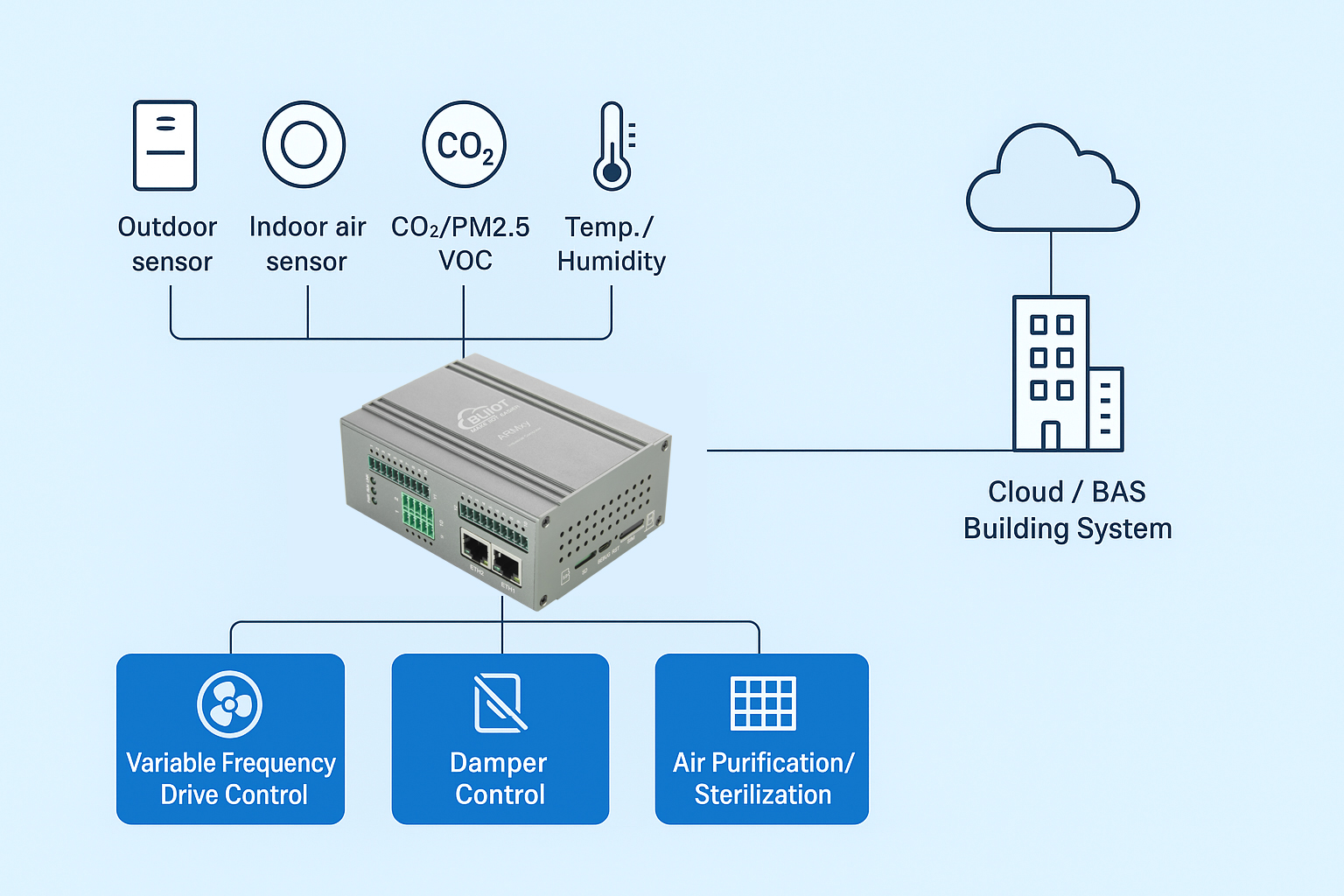
Achieves full closed-loop control with response times under 500 ms.
Real-World Application Scenarios
- Office Buildings & Schools Dynamic fresh air adjustment based on real-time occupancy/CO₂ in meeting rooms and classrooms → 30%–45% energy savings
- Shopping Malls & Large Public Venues Zone-based control with multi-sensor coordination for optimal air quality
- Hotels Integrated with PMS: automatic ventilation when occupied, energy-saving purification mode when vacant
- Hospitals & Clean Rooms Precise differential pressure control, rapid pollutant removal, HEPA filter status monitoring
- Underground Parking & Transportation Hubs Intelligent exhaust based on CO/NO₂ levels, ensuring both safety and energy efficiency
Core Value Proposition
- Superior Indoor Air Quality (IAQ) and occupant well-being
- Significant energy reduction (30%–50% overall savings)
- Rock-solid reliability and localized data security
- Seamless integration with existing building systems
- Future-proof: ready for AI and full digital transformation
Conclusion The ARM edge controller-powered fresh air system is evolving from “passive ventilation” to “active intelligent control” and will become a standard component in next-generation smart, green, and carbon-neutral buildings.


