In industrial environments, many communication issues arise not because devices do not support Modbus, but because communication parameters, device addresses, and interface resources are not directly compatible.
Case Details
In industrial environments, many communication issues arise not because devices do not support Modbus, but because communication parameters, device addresses, and interface resources are not directly compatible.
Recently, a typical communication challenge occurred during a factory energy retrofit project: four flowmeters shared the same Modbus address, and an additional Modbus energy meter with different communication parameters needed to be integrated. Crucially, the flowmeters and energy meters were already protected by physical security seals, meaning device addresses could not be modified on-site. Ultimately, the built-in RS485 port of the BL190 played a decisive role at the critical moment.
Project Site: BL118 + BL190
The project focuses on factory energy-saving renovation, requiring the collection of flow, energy consumption, and analog data. The architecture utilizes a BL118 controller paired with a BL190 EdgeIO controller.
|
Device
|
Primary Role
|
Communication Method
|
|
BL118
|
Data aggregation, upper-level communication, logic linkage, edge computing
|
MQTT
|
|
BL190
|
AI acquisition, field device access
|
Modbus TCP + RS485
|
|
Flowmeters (x4)
|
Field flow data acquisition
|
Modbus RTU
|
|
Energy Meter (x1)
|
Power data acquisition
|
Modbus RTU
|
|
AI Signals (x8)
|
Process parameter acquisition
|
Analog Signal
|
The BL190 is configured with 8 AI channels for analog signals, while the BL118 communicates with the BL190 via Modbus TCP. Although the architecture was clear, problems emerged during the integration of the flowmeters and energy meter.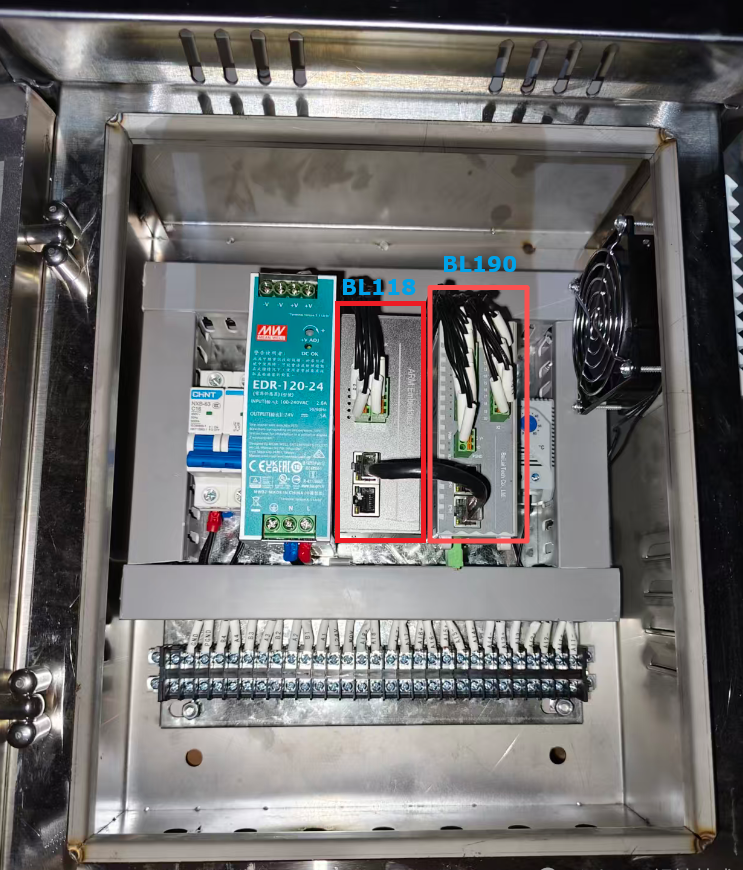
Four Flowmeters with Identical Addresses
The site required data from four flowmeters. Site verification confirmed that while all four were Modbus devices, their slave addresses were identical. Normally, multiple Modbus RTU devices on the same RS485 bus must have unique addresses for the master to distinguish them.
|
Device
|
Protocol
|
Modbus Address
|
Baud Rate
|
|
Flowmeter 1
|
Modbus RTU
|
Identical
|
Same
|
|
Flowmeter 2
|
Modbus RTU
|
Identical
|
Same
|
|
Flowmeter 3
|
Modbus RTU
|
Identical
|
Same
|
|
Flowmeter 4
|
Modbus RTU
|
Identical
|
Same
|
|
Energy Meter
|
Modbus RTU
|
Independent
|
Different
|
Directly connecting these four flowmeters in parallel to a single RS485 bus would result in address conflicts, making it impossible for the master station to distinguish between them.
Obstacles to Modifying Addresses: On-site Security Seals
Theoretically, the most direct solution is to reconfigure the Modbus addresses. However, industrial reality is more complex. The flowmeters and energy meters were managed under security seals. Parameters cannot be changed at will by engineering personnel. Modification would require a lengthy administrative process: Application → Site Approval → Authorization → Unsealing → Parameter Modification → Resealing.
|
Solution
|
Feasibility
|
Implementation Difficulty
|
|
Modify flowmeter addresses
|
Theoretically feasible
|
❌ Requires long approval cycle
|
|
Parallel connection
|
❌
|
Address conflict
|
|
Shared RS485 bus
|
❌
|
Incompatible communication parameters
|
|
Add new communication nodes
|
✅
|
Rapid implementation
|
|
Use BL190 RS485 for energy meter
|
✅
|
Simple modification
|
Therefore, while "changing addresses" is a technical solution, it was not the most suitable engineering solution for this project.
Further Complications: Inconsistent Baud Rates
The energy meter's baud rate differed from that of the flowmeters. Even if address conflicts were ignored, the energy meter could not share the same RS485 bus due to these mismatched communication parameters. The project faced several simultaneous constraints:
- Address Conflict: Four flowmeters could not be distinguished.
- Parameter Mismatch: The energy meter baud rate was incompatible with the flowmeters.
- Physical Restrictions: Security seals prevented immediate parameter adjustment.
- Process Delay: Approval cycles for modifications were unpredictable.
BL190 RS485 Interface Implementation
The BL190 features one isolated RS485 port that supports both Modbus RTU Master and Slave modes. The specification confirms the RS485 interface can act as a Modbus RTU Master to directly connect smart instruments and sensors. The solution became clear: rather than altering flowmeter addresses or forcing shared communication, the energy meter was connected independently to the BL190's RS485 port.
Final Architecture: Energy Meter to BL190, BL118 via Ethernet
The data link was restructured as follows:
- Energy Meter → BL190: RS485 / Modbus RTU (BL190 reads energy meter data).
- Internal BL190: Register Mapping (Energy meter data is mapped to local registers).
- BL190 → BL118: Ethernet / Modbus TCP (BL118 reads energy data from BL190).
- BL118 → Upper System: Project Communication Method (Unified upload of energy data).
BL190 for Acquisition, BL118 for Aggregation
As a Modbus RTU Master, the BL190 reads data according to the energy meter's specific parameters. The BL190 RS485 port supports baud rates from 2400bps to 230400bps and various parity checks (None, Even, Odd). Once acquired, the energy data (Voltage, Current, Active Power, Power Factor, and Accumulated Energy) is mapped to BL190 registers. The BL118 then simply retrieves this data via Modbus TCP without needing to interface directly with the energy meter.
The Strategic Importance of the RS485 Interface
The single RS485 port on the BL190 proved to be a decisive factor for successful equipment integration. Beyond communication, the BL190 provides versatile capabilities:
- Isolated RS485: For Modbus RTU instrument access.
- Modbus RTU Master: Active polling of energy meters.
- Modbus TCP: Providing unified data to the BL118.
- I/O Expansion: Support for 1 to 3 modules (Digital, Analog, Temperature).
- Edge Processing: Web-based configuration and register-based data operations.
Project Conclusion
Industrial projects often demonstrate that what is technically possible may not be engineered-feasible due to administrative or physical constraints. When device parameters cannot be moved, the most effective strategy is to change the access method. By using the BL190 to provide an independent RS485 access point, the project achieved unified data integration via Modbus TCP without breaking security seals or waiting for lengthy approvals.


